PIC/S has published PI 058-1, its interpretation of the most important changes in the revised EU GMP Annex 1 on the manufacture of sterile products (2022). For cleaning validation, the sections on chemical residues, on the bio-decontamination of isolators and RABS, and on the distinction between disinfection and sterilisation are particularly relevant.

What PI 058-1 is — and what it is not
PI 058-1 was published by PIC/S on 28 October 2026 under the title Interpretation of the Most Important Changes in the Annex 1 on the Manufacture of Sterile Products (2022). The 29-page document was prepared by a joint working group of PIC/S, the EMA and the WHO with the aim of harmonising the interpretation of the revised Annex 1 during GMP inspections.
The recommendation does not introduce new GMP requirements. It clarifies how existing requirements are understood and how they can be implemented in practice. For manufacturers of sterile medicinal products it still matters: it indicates what evidence inspectors may expect when they assess contamination control, cleaning and bio-decontamination.
Why residue control matters in isolators and RABS
A key point concerns the control of residues from cleaning agents, disinfectants and bio-decontamination processes. For isolators and restricted access barrier systems (RABS), demonstrating the microbiological efficacy of a decontamination process alone is not sufficient.
Manufacturers must also assess whether chemical substances remain on surfaces and could affect the quality of the medicinal products manufactured. The Q&A on Section 4.22 of Annex 1 highlights:
- a traceable assessment of potential chemical residues,
- scientifically justified cleaning and decontamination procedures,
- suitable validation evidence for residue control,
- risk-based selection of sampling locations and control measures, and
- consideration of potential effects on product quality and stability.
Practical example: where an isolator is bio-decontaminated with vaporised hydrogen peroxide (VHP), the manufacturer must evaluate whether residual deposits or penetration of the decontaminant into materials and containers pose a quality risk. The evidence required depends on the equipment design, the materials used, exposure conditions and the process sequence.
Cleaning and bio-decontamination are different processes
Cleaning serves in particular to remove unwanted chemical and product-related residues and other contamination. Bio-decontamination is intended to reduce microbial contamination by suitable procedures. Sterilisation pursues a different, specifically defined objective in terms of sterility assurance.
PIC/S explicitly clarifies that VHP surface bio-decontamination cannot automatically be regarded as a sterilisation process. Where VHP is intended to be used for sterilisation, appropriate evidence of an equivalent level of sterility assurance is required. Restricted penetration, shielded surfaces, material properties and process conditions must be taken into account.
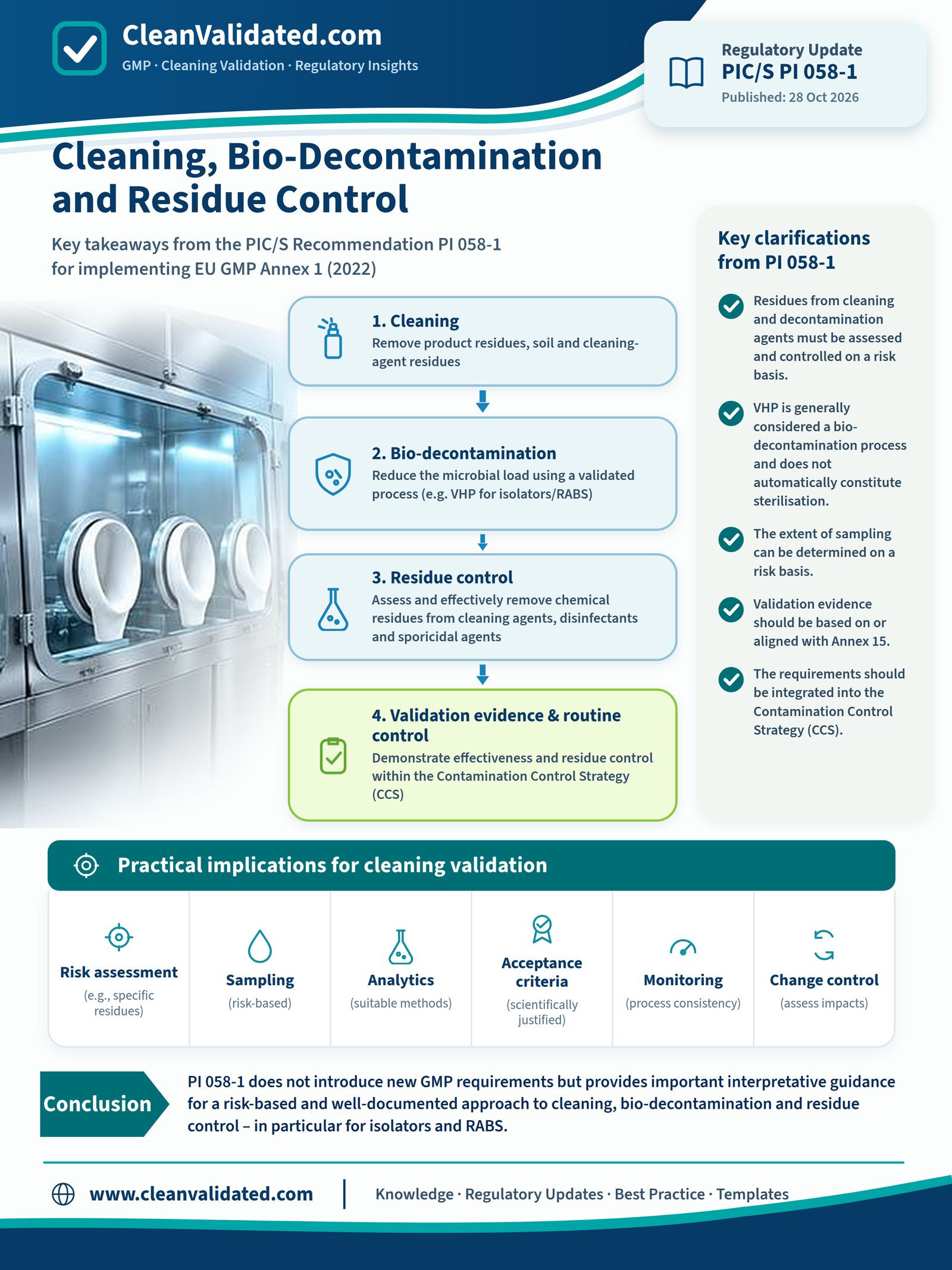
For qualification and validation documentation this means: procedures, acceptance criteria and evidence must correspond to the process objective claimed in each case.
What this means for cleaning validation
From PI 058-1, several practical review questions can be derived for existing validation systems:
- Residue risks: are cleaning and decontamination agents adequately assessed alongside product-related residues?
- Sampling: are critical, hard-to-reach or highly exposed surfaces taken into account when defining the sampling plan?
- Analytics: are the test methods suitable for the relevant residues and sufficiently sensitive?
- Acceptance criteria: are the limits scientifically justified and aligned with the actual quality risk?
- Routine monitoring: is there a traceable link between validation results, ongoing process control and the contamination control strategy (CCS)?
- Change management: are changes to decontamination agents, equipment configurations or process parameters assessed for their impact on the validated state?
These review questions are practice-oriented derivations from the document, not an additional binding PIC/S checklist.
HBEL, PDE and MACO: what changes?
PI 058-1 introduces neither a new PDE calculation method nor a new general MACO formula. Health-based exposure limits and scientifically justified acceptance criteria remain decisive for classic cleaning validation of shared production equipment.
For residues of disinfectants and decontamination agents, however, a purely classical carry-over assessment is not sufficient. Depending on the substance and process, additional elements may be required:
- a toxicological assessment of potential patient exposure,
- an investigation of potential interactions with the medicinal product,
- an assessment of potential effects on product stability, and
- suitable substance-specific or risk-based acceptance criteria.
A blanket transfer of API MACO limits to all cleaning chemicals is therefore not scientifically justified.
Implications for the contamination control strategy
The contamination control strategy is intended to systematically capture and control the significant contamination risks of a manufacturing process. Cleaning validation, disinfection validation and bio-decontamination should therefore not be treated as isolated documentation packages.
Instead, it must be ensured that the individual measures are coordinated: selection of suitable agents, validation of their efficacy, assessment of potential residues and definition of appropriate ongoing monitoring.
Validation takeaway
PI 058-1 is not a new GMP regulation and does not establish additional statutory limits. It provides orientation for interpreting requirements that already apply under Annex 1. Manufacturers of sterile products should review their existing cleaning and bio-decontamination procedures for isolators and RABS, focusing on chemical residue control, appropriate validation evidence and traceable integration into the CCS.
A blanket re-validation of all cleaning processes cannot be derived from PI 058-1.
Primary regulatory references
- PIC/S (2026): PI 058-1, Interpretation of the Most Important Changes in the Annex 1 on the Manufacture of Sterile Products (2022), 28 October 2026, in particular the Q&A on Sections 4.21 and 4.22. Direct link
- PIC/S (2026): Official announcement on the adoption and entry into force of PI 058-1. Direct link
- European Commission: EudraLex Volume 4, EU GMP Annex 1, Manufacture of Sterile Medicinal Products, 2022 version. Direct link
Editorial note: this article explains regulatory requirements and possible practical implementation. Its applicability must always be assessed on the basis of the specific product, process and regulatory scope.

