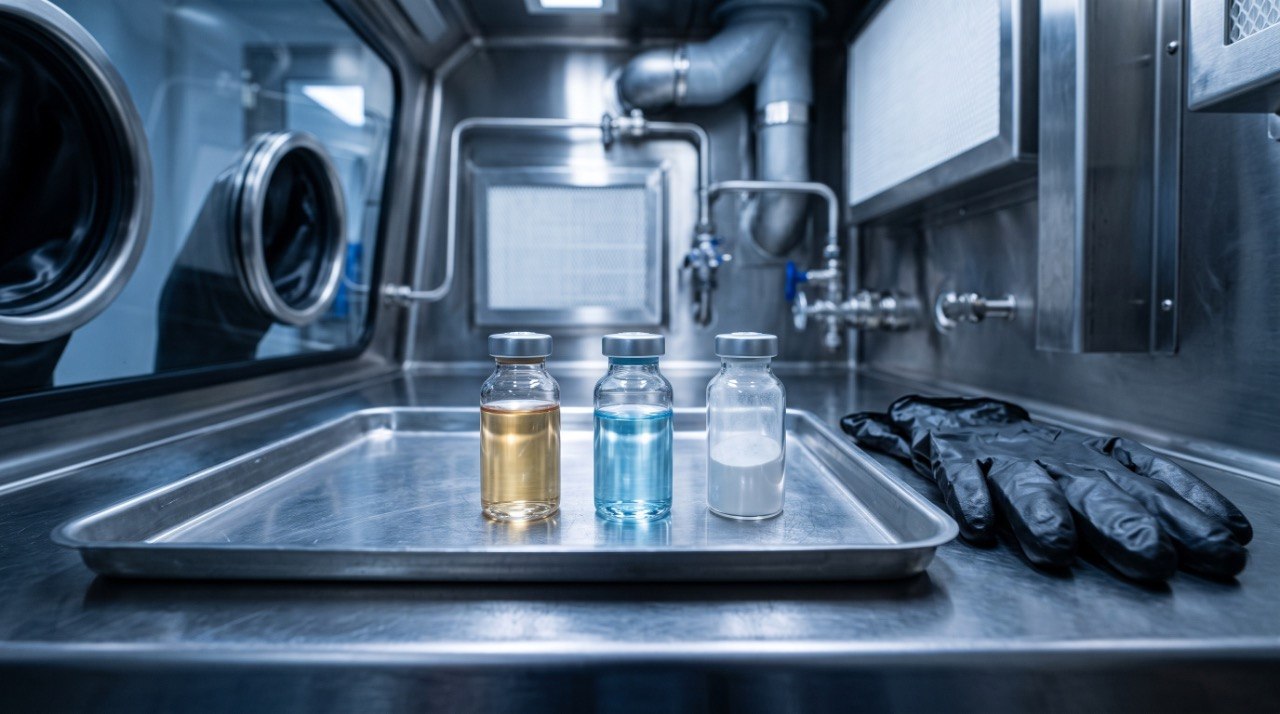
INTERPHEX 2025 in New York put cleaning validation on the process-monitoring agenda: a dedicated panel on analytics, contamination control and sustainability, plus cleanroom and environmental-monitoring sessions. Industry-press report from Javits Center, 1-3 April 2025.
New York's Javits Center hosted INTERPHEX 2025 on 1-3 April 2025. Across 45-plus curated education sessions, one cleaning-validation panel put analytics, contamination control and sustainability on the same agenda — a signal that cleaning is being folded into the process-monitoring conversation. What follows is drawn from industry-press coverage and organizer material, not from peer-reviewed evidence.
What happened
INTERPHEX 2025 ran at the Jacob K. Javits Convention Center in New York City from 1 to 3 April 2025, with the exhibit hall open 10:00-17:00 Tuesday and Wednesday and 10:00-14:00 Thursday. The organizer's Learning Lab schedule lists a panel discussion, Optimizing Cleaning Validations: Analytics, Contamination Control and Sustainability Strategies, on Tuesday 1 April at 10:30 on Track 1. Conference reporting by Bioanalysis Zone (RX Global) confirms the session ran and frames its takeaways plainly: improved outcomes, cost efficiency and environmental responsibility, with the blunt conclusion that "optimization is no longer optional."
Cleanroom contamination control had its own presence. Vileda Professional hosted an open panel and technical seminar on 1 April, 2:00-2:30 PM EST on Stage 5, with Anne Marie Dixon of Cleanroom Management Consultants, Jim Polarine of Steris, and Leo Gubenko and Fred Cecala of Vileda. Separately, PDA ran expert-guided tours on 1 April, including Cleanroom Cleaning and Disinfection — built on PDA Technical Report No. 70 — and Environmental Monitoring Sampling for isolator/RABS gloves.
Why it matters
Cleaning validation has traditionally been treated as a documentation exercise completed at Stage 2 and revisited only at change control. The 2025 programme suggests the field is being pulled toward continuous verification: analytics feeding residue data, contamination-control strategy framing the cleaning programme, and sustainability emerging as a design constraint alongside residue limits.
Three consequences deserve attention. First, if cleaning performance is monitored continuously, sampling plans, hold times and worst-case rationale must be defensible over time, not just at qualification. Second, analytical methods move from campaign support to standing surveillance — method capability defines what "in control" can mean. Third, shared-equipment strategies must absorb this shift: a MACO calculated once does not survive an argument that the cleaning process is monitored and must be re-justified whenever data drifts.
What is particularly interesting
The most useful detail is the pairing of "analytics" with "contamination control" in a single session title. Cleaning and environmental monitoring have long lived in different departments with different acceptance criteria. Putting them on one panel implies industry is starting to reason about residues, microbial control and cleanroom practices as one risk picture — precisely what a formal contamination-control strategy demands. Sustainability as a third axis is newer, and cuts against the reflexive answer of more water, more detergent, more sampling.
Questions for our programme
- If cleaning is monitored continuously, what triggers revalidation versus routine trending — and who owns that decision?
- Do our swab and rinse recovery studies hold up when the same methods serve surveillance rather than one-off qualification?
- How do we keep visually clean, analytically clean and microbially controlled acceptance criteria aligned in one document?
- Which of our worst-case products and hold times are justified by data we would defend during an inspection?
Sources
- Bioanalysis Zone, Round-up of INTERPHEX 2025 (industry press)
- INTERPHEX 2025 Learning Lab schedule, organizer PDF (schedule as of 19 March 2025)
- INTERPHEX show information, April 1-3, 2025, Javits Center NYC
- PDA, PDA at INTERPHEX 2025 (association programme)
- Cleanroom Technology, Vileda Professional to host contamination control seminar at INTERPHEX 2025, 11 March 2025 (trade press)
Validation takeaway
INTERPHEX 2025 signals a shift from one-off cleaning qualification toward continuous verification: analytics, contamination-control strategy and sustainability are converging on the cleaning suite. If cleaning becomes monitored, sampling plans, hold times, worst-case rationale and MACO justification must survive ongoing scrutiny, not just Stage 2.
Questions worth asking in our own programme
- If cleaning is monitored continuously, what triggers revalidation versus routine trending, and who owns that decision?
- Do our swab and rinse recovery studies hold up when the same methods serve surveillance rather than one-off qualification?
- How do we keep visually clean, analytically clean and microbially controlled acceptance criteria aligned in one document?
- Which of our worst-case products and hold times are justified by data we would defend during an inspection?