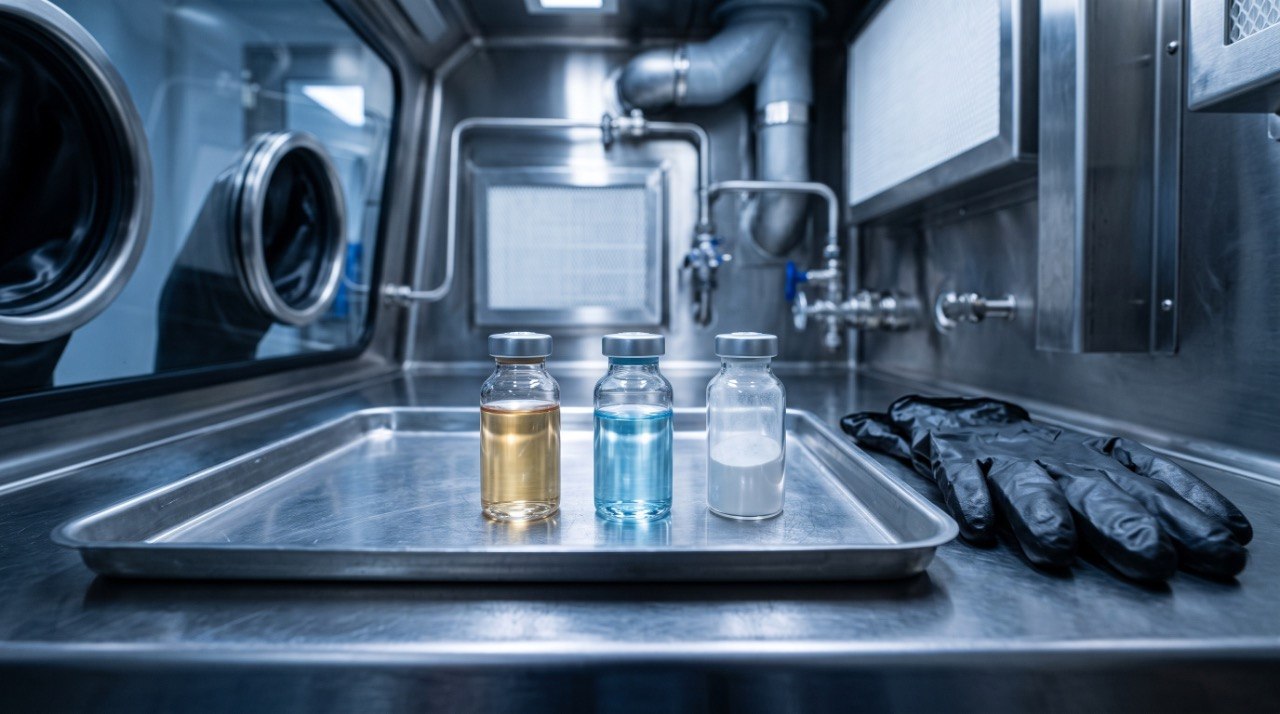
A NIPER-Ahmedabad group pairs a validated RP-HPLC surface-residue method for three SGLT-2 inhibitors with a detoxification strategy for the resulting cleaning waste.
Cleaning Validation Meets Waste Treatment: A Study of SGLT-2 Inhibitor Residues
Cleaning is only half the job. A recent study links validated residue control for three gliflozins to the treatment of the effluent the cleaning step produces.
What happened
The authors report a study on cleaning and detoxification of three sodium-glucose cotransporter-2 (SGLT-2) inhibitors — empagliflozin (EMPA), dapagliflozin (DAPA) and canagliflozin (CANA) — published in Microchemical Journal (Vol. 209, 112587; Akhare, Rajput, Jadav and Sengupta, NIPER-Ahmedabad). Their premise is a familiar duality: cleaning validation prevents batch-to-batch cross-contamination, while the cleaning waste itself becomes an environmental and public-health problem if the active is simply washed down the drain.
The team developed and validated a reversed-phase HPLC method quantifying all three drugs simultaneously on manufacturing surfaces, then used it to score cleaning agents against stainless steel and glass coupons. The authors report that mean swab recovery exceeded 86 % from both surface types for each drug, and that residues of all three compounds were completely removed by 30 % isopropanol and by 30 % acetone. A detergent option — 10 mM SDS with 20 % IPA — performed slightly worse than IPA or acetone alone. On the waste side, detoxification exceeded 90 % using sodium hypochlorite and NaOH.
Why it matters
Most published cleaning-validation work stops at the swab result. This paper carries the residue story into the effluent stream and treats both as one control problem. For multi-product facilities running gliflozin campaigns that framing matters: a cleaning agent that removes an API from stainless steel but leaves a biologically active parent compound in the wash water has relocated the risk rather than removed it.
The recovery figures are the practically useful part. Swab recovery above 86 % from stainless steel and glass sits comfortably inside normal acceptance expectations, and it was established for three distinct analytes in one method — the kind of multi-analyte panel that spares a shared-equipment campaign three separate analytical validations.
What is particularly interesting
The cleaning-agent comparison is unusually honest. SDS is often reached for as the safe, effective, "proper" detergent choice, yet a 10 mM SDS / 20 % IPA blend was slightly less effective here than the two plain solvent systems — a useful counterweight to the reflex that adding surfactant always improves removal. The detoxification arm is the genuinely novel piece: sodium hypochlorite and NaOH each delivered > 90 % degradation of residual drug in the cleaning waste, converting "what do we do with the wash water?" from a disposal question into a validated treatment step.
Limitations
This is a coupon-level, laboratory-scale investigation. It does not report performance on full production equipment, under real worst-case hold times, or across repeated campaigns, so transfer to a site protocol still needs site-specific verification. The abstract discloses no LOQ/LOD, linearity ranges, extraction-efficiency correction, contact times or temperatures.
Detoxification measured as percentage removal of parent compound does not by itself establish that the degradation products are non-hazardous. No effluent toxicity testing is reported in the accessible material.
Questions for our programme
- What is the validated LOQ, and does it sit below the calculated MACO for each of the three gliflozins in our product mix?
- Are the reported swab recoveries corrected for extraction efficiency, and which swab material and wetting solvent were used?
- Would our cleaning waste tolerate sodium hypochlorite treatment, given material compatibility and the risk of chlorinated by-products?
- What degradation products do NaOH and hypochlorite form, and how were they characterised?
Sources
Akhare, H., Rajput, N., Jadav, T., Sengupta, P. (2025). Development of a comprehensive cleaning and detoxification approach for selected sodium-glucose cotransporter-2 inhibitors including establishment of highly sensitive analytical method for their simultaneous surface residue estimation. Microchemical Journal, 209, 112587. https://doi.org/10.1016/j.microc.2024.112587
Validation takeaway
A cleaning agent that removes an API from stainless steel but leaves biologically active parent compound in the wash water has relocated the risk, not removed it — validated residue control and waste detoxification belong in the same protocol. Treat coupon-level cleaning-agent comparisons (here: plain 30 % IPA and 30 % acetone beating a 10 mM SDS / 20 % IPA blend) as screening data to be confirmed on site-specific worst-case equipment before adoption.
Questions worth asking in our own programme
- What is the validated LOQ, and does it sit below the calculated MACO for each of the three gliflozins in our product mix?
- Are the reported swab recoveries corrected for extraction efficiency, and which swab material and wetting solvent were used?
- Is sodium hypochlorite waste treatment compatible with our equipment materials and effluent permit, and what chlorinated by-products could form?
- How were the degradation products of NaOH and hypochlorite detoxification characterised, and were they tested for residual activity?