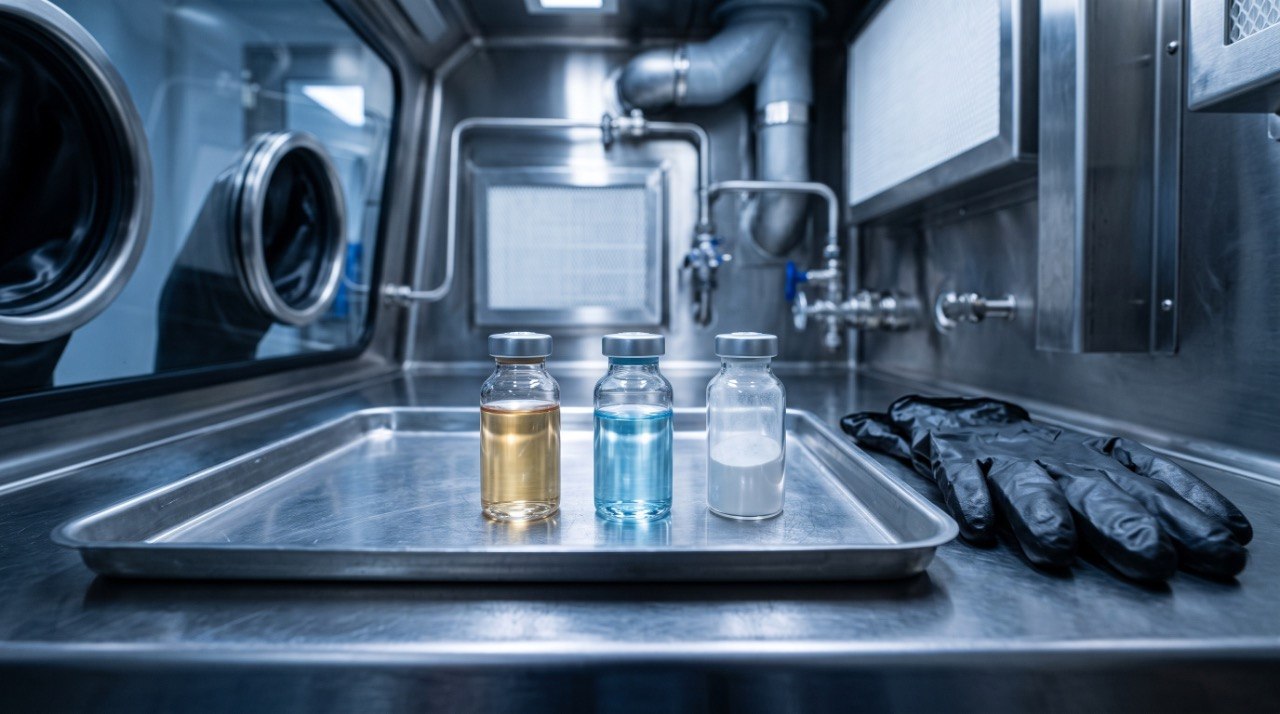
TOC can live on the QC bench, on the shop floor next to the vessel, or plumbed into the CIP skid. The instrument is the same; the sampling chain — and therefore the meaning of the number — is not.
Lab, At-Line, Online, In-Line: Where Does TOC Fit?
Standfirst — Total organic carbon (TOC) is one of the few cleaning-validation methods that can sit on the bench, on the shop floor or inside the clean-in-place (CIP) skid. Moving the analyser moves the sample: what we measure, how fast we see it, and how defensible the result is. Placement is a validation decision, not a purchasing one.
What happened
On 23 April 2025, Veolia's Sievers Resource Center published a comparison of the three common TOC deployments in cleaning validation — laboratory, at-line and online. At-line is defined as a portable analyser placed directly next to the equipment being cleaned, measuring swab or rinse samples within minutes of collection. Online is analysis of the final-rinse slipstream, with CIP automation diverting rinse to an integrated analyser and exporting data to the site data host.
ISPE's Pharmaceutical Engineering frames TOC the same way: either a laboratory method or integrated process analytical technology (PAT) positioned at-line or continuously online within CIP systems. In 2025 ASTM also issued E2656-25, a practice for real-time release testing of pharmaceutical water for the TOC attribute — which formalises what an online TOC measurement must demonstrate before it carries a release decision.
Why it matters
Placement rewrites the sampling chain. In the lab the sample is a proxy: swab recovery and rinse volume stand in for the surface. Online, the rinse stream itself is the sample — fewer handling steps, less contamination and hold-time risk, but a different relationship to the surfaces we care about, because a wall that was not wetted is not measured.
TOC is non-specific: one number for everything oxidisable. That is its strength — API, degradants, excipients and detergent residues in a single test — and the reason "real time" must be read carefully. Real time here means the rinse residue profile as it develops, not identification of what is present. A rapid non-specific result can release equipment only if the worst-case residue has been shown to respond adequately to TOC and the acceptance criteria were justified in advance.
What is particularly interesting
The economics are the visible driver: online TOC moves equipment release from days to minutes and compresses clean hold times; at-line delivers results in minutes without waiting on QC workflow and without modifying the CIP skid. Online monitoring also gives inorganic carbon, TOC and conductivity together, supporting root-cause analysis rather than pass/fail.
The subtler point is trending. An online analyser reading 300 ppb against a 500 ppb compendial limit can still be a serious signal if the historical baseline is 50 ppb. Alert and action levels derived from validated trending data catch out-of-trend behaviour long before out-of-specification — something grab sampling at release frequency cannot do.
What could we learn
- Let the sampling strategy choose the placement, not the reverse. At-line suits campaigns and clean hold-time pressure; online suits automated, high-throughput CIP trains; the lab stays the reference for validation studies and investigations.
- "Real time" is not "real release". Online deployment is PAT; the method must still be validated (USP <643>, ICH Q2(R2), linearity, accuracy, LOD/LOQ, recovery) with 21 CFR Part 11 compliant data handling.
- For a non-specific method, scientific justification means naming the worst-case or most difficult-to-detect residue and demonstrating its TOC response.
- Lab-to-online transfer is a project: comparability protocol, agreed acceptance criteria, and assessment of differences from temperature, sample handling or tubing.
Questions for our programme
- Which residue is TOC worst case per equipment train, and what is its response factor against our limit?
- Do we hold a written comparability protocol for moving a validated lab TOC method to at-line or online?
- Is our bottleneck analysis time, sample hold time, or the QC release workflow?
- If online: which final-rinse point is worst case, and what flow, interface and alarm logic are specified?
- What alert and action levels follow from our own historical TOC baseline?
Wider context
Regulators have accepted TOC for cleaning validation for two decades provided its use is justified — reinforced by the science- and risk-based method selection logic of ASTM E3106 and by EMA/PIC-S expectations on residue-specific limits. The chemistry has not changed; the deployment envelope has. PAT, automation and data integrity now make the placement question unavoidable in a cleaning validation master plan, and the answer should be traceable to the sampling strategy, the residue risk assessment and the release workflow.
Sources
- Veolia Sievers Resource Center, "How Does Cleaning Validation Testing in the Lab Compare to Online or At-line Cleaning Validation?", 23 April 2025.
- ISPE, Pharmaceutical Engineering, "TOC Analysis for Cleaning Validation".
- ASTM E2656-25, Standard Practice for Real-time Release Testing of Pharmaceutical Water for the Total Organic Carbon Attribute, 2025.
- Walsh A. et al., "Risk-Based Analytical Method Selection in Cleaning Validation Using ASTM International Standards", Pharmaceutical Online.
Validation takeaway
TOC placement is a validation decision: lab, at-line and online deployments differ in sample origin, hold time, data integrity exposure and release meaning, so the choice must be justified from the sampling strategy and residue risk assessment — and a non-specific method must still prove its response to the worst-case residue before it can carry a release decision.
Questions worth asking in our own programme
- Which residue do we designate as the TOC worst case per equipment train, and what is its response factor against our acceptance limit?
- Do we hold a written comparability protocol for transferring a validated laboratory TOC method to at-line or online deployment?
- Is our bottleneck analysis time, sample hold time, or the QC release workflow?
- If online: which final-rinse point represents worst case, and what sampling flow, interface and alarm logic are specified?
- What alert and action levels would we derive from our own historical TOC baseline to catch out-of-trend results before they become out-of-specification?