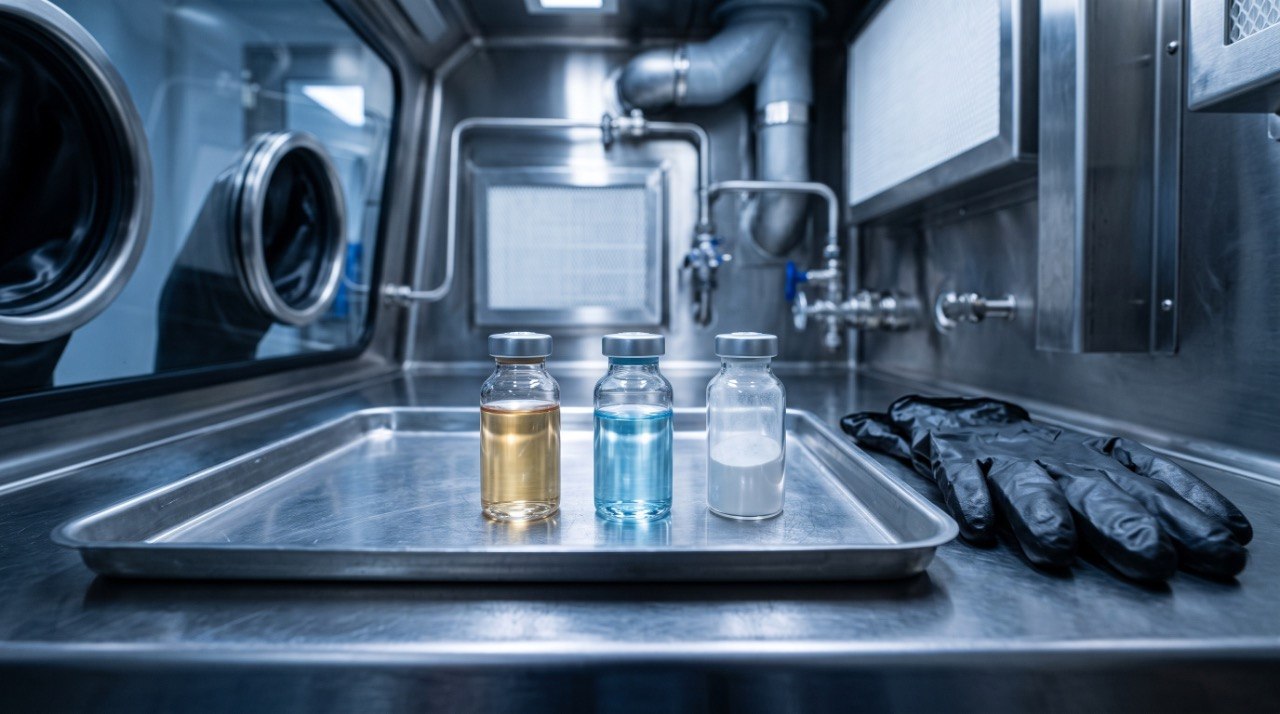
ASTM Work Item WK92599 would give total organic carbon analysis its own dedicated guidance for swab and rinse samples — and force cleaning programmes to defend recovery and limits, not just concentrations.
ASTM Work Item WK92599 would give TOC analysis the same dedicated treatment that swab and rinse sampling already receive — and force programmes to argue method fitness and recovery, not merely concentration.
What happened
ASTM Committee E55 (Manufacture of Pharmaceutical and Biopharmaceutical Products) carries an open Work Item, WK92599 — "New Guide for Using Total Organic Carbon (TOC) Analysis in Cleaning Validation" — under Subcommittee E55.14 (Measurement Systems and Analysis), staff manager Travis Murdock.
According to the ASTM work-item record, its scope is to "describe best practices for the development and implementation of TOC Analysis as a method for analyzing swab and rinse samples in cleaning validation studies." The stated rationale is blunt: "There is currently no guidance on how to use TOC Analysis in Cleaning Validation although it is now in wide spread use. Many misconceptions about its use need to be dispelled and clarified." The item is expressly positioned to support ASTM E3106, the 2017 guide for science- and risk-based cleaning process development and validation.
At the point when this item first became publicly tracked in late October 2024, it was newly opened. In January 2025 ASTM's cleaning standards team described it in Pharmaceutical Online as a work item that "has just started," alongside WK92659 (swab and rinse recovery), created but not yet worked on.
Status note. As of 18 September 2026, WK92599 still appears on ASTM's E55.14 jurisdiction page as a Work Item — a "New Guide" — i.e. not a published standard. Work items change without notice; beyond that listing, the current balloting position is not independently verifiable.
Why it matters
TOC is a non-specific, carbon-based method: any carbon-containing species oxidised to CO2 contributes to the result — active substance, excipients, degradation products, detergent residues alike. That is its economy and its hazard: one method can cover a multi-product facility and collapse the method-transfer problem, but the number it returns is a sum, not an identity — a TOC concentration, not a statement that a named substance sits below its health-based limit.
The distinction is decisive. A specific method (HPLC, UV) measures the residue for which a toxicological limit has been justified; TOC measures everything carbon-bearing, so its acceptance limit must be defended differently — typically as a surrogate anchored to the worst-case compound in the matrix.
Guidance has been missing precisely at that interface: how the method is developed and qualified, how recovery is established, and how limits are set to survive inspection.
What is particularly interesting
Recovery is the hinge. Published comparison work reported rinse sampling recovering under 20% for two ointment residues, while swab sampling with direct combustion recovered roughly 100% for every tested substance, water-soluble or not. That is not a methodological preference; it is a factor-of-five difference in the limit a programme can substantiate.
ASTM is writing TOC and swab/rinse recovery guidance as separate work items (WK92599, WK92659) — reasonable, since recovery is method-agnostic, but it means a reader will need both.
Older TOC method-development literature sets out the capability parameters needed: linearity, MDL, LOQ, accuracy, precision, swab recovery, and control of blank carbon from swab material, rinse water and sample handling.
What could we learn
- Non-specific does not mean non-validated: a TOC method used for release-relevant decisions needs the same formal capability data as any other method.
- Blank and carrier control carry more weight with TOC, because swabs, rinse water and handling all contribute carbon.
- Recovery must be established per residue class and per sampling mode; a single assumed recovery factor is an unvalidated assumption.
- Where TOC serves as a surrogate, the worst-case compound selection logic must be documented and defensible.
Questions for our programme
- Which residues in our cleaning matrix are poorly recovered by rinse sampling (ointments, non-polar actives) — and does our TOC limit still hold at a recovery factor of 0.2?
- Have we established swab and rinse recovery for TOC specifically, with blank contributions quantified?
- Is our TOC acceptance limit derived from a toxicologically justified worst-case compound, or inherited from a specific-method limit?
- Do we have data showing the TOC method is fit for the full matrix (detergent, excipients, degradation products), not just the API?
- If WK92599 is published, would our existing method qualification satisfy its expectations — or would revalidation be required?
Wider context
WK92599 sits in a cluster: WK78595 (CIP clean-by-design), WK86188 (risk assessment of cleaning programmes), WK92658 (process capability) and WK92659 (swab/rinse recovery), all supporting the E3106 framework. Published precursors include E3263 (visual inspection qualification) and E3418 (residue limit calculation). TOC guidance is the analytical-method piece of that architecture — the one that decides what the numbers on the certificate actually mean.
Sources
- ASTM International, Work Item WK92599, "New Guide for Using Total Organic Carbon (TOC) Analysis in Cleaning Validation" (astm.org work-item page; checked 18 September 2026)
- ASTM International, Subcommittee E55.14 on Measurement Systems and Analysis, jurisdiction listing (checked 18 September 2026)
- ASTM International Cleaning Standards Team, "ASTM International Pharmaceutical Cleaning Standards: Current Status And Future Direction," Pharmaceutical Online, 2 January 2025
- Center for Pharmaceutical Cleaning Innovation (CPCI), proposed standards list
- "How to Develop and Validate a Total Organic Carbon Method for Cleaning Applications," PDA J. Pharm. Sci. Technol. 55(5):290
- "Carbon Measurement Methods for Cleaning Validation," Pharmaceutical Technology
Validation takeaway
TOC is a non-specific sum, not an identity: its acceptance limit can only be defended through documented worst-case selection, matrix-appropriate method capability and per-mode recovery data. ASTM WK92599 is the guidance piece that has been missing at that interface — watch it, and pre-check your current qualification against it.
Questions worth asking in our own programme
- Which residues in our cleaning matrix are poorly recovered by rinse sampling, and does our TOC limit still hold at a recovery factor of 0.2?
- Have we established swab and rinse recovery for TOC specifically, with blank contributions quantified?
- Is our TOC acceptance limit derived from a toxicologically justified worst-case compound, or inherited from a specific-method limit?
- Do we have data showing the TOC method is fit for the full matrix, not just the API?
- If WK92599 is published, would our existing method qualification satisfy its expectations, or would revalidation be required?