Manual wipe cleaning in pharmaceutical manufacturing
Clean Validated | Whitepaper | Version 2.1 | 27 October 2026
A practical evidence review for QA, validation, production, microbiology and analytical teams.
Executive summary
Manual wipe cleaning in pharmaceutical manufacture is not a single technique with a universal recipe. It is a coupled process in which wetting, chemistry, mechanical action, surface condition, wipe construction, operator behaviour, drying, residue formation and analytical recovery interact. The intended outcome must therefore be defined before the wipe is selected. Removal of an active pharmaceutical ingredient, protein, DNA, microorganism, spore, virus, endotoxin, detergent or disinfectant residue is not one generic endpoint.
This chapter establishes the boundaries for a scientifically defensible cleaning programme. It distinguishes product-contact equipment from environmental surfaces, sterile from nonsterile operations, cleaning from disinfection and a cleaning wipe from a sampling wipe. It also separates three outcomes that are often conflated: physical removal from the original surface, chemical or biological inactivation, and transfer to the wipe or to a secondary surface. A negative culture, PCR result, ATP result, visual inspection or TOC result answers a different question; none should silently be treated as proof of every other outcome.
The literature supports a risk-based, site-specific qualification strategy, not a universal wipe pattern or fixed pressure, overlap, speed, area, contact time or number of usable wipe faces. Direct pharmaceutical evidence remains limited and is supplemented here by cell-processing, clinical, virological, food and analytical studies whose transfer limits are explicit. This whitepaper supports process development and critical review. It is not a site SOP or evidence that an installed cleaning process has been validated.
Reading guide
- Purpose, scope and outcomes
- Defining and observing the wiping technique
- Critical synthesis of the evidence
- Designing qualification and validation
- Sampling and interpreting the result
- Investigating failures
- Implementation and lifecycle
- Sources
The companion article introduces the series. Five focused articles cover outcomes, technique, wipe-system selection, sampling and study design. The toolkit contains T01-T07 development forms and T08 for chemical-result conversion. Posters are training aids with a defined claim boundary.
Eight takeaways
- Define the target first: product residue, biological contamination, endotoxin, visible soil, cleaning-agent residue and operator exposure are different control problems.
- Cleaning, disinfection, sanitization, deactivation and depyrogenation are related but non-equivalent activities.
- A wipe can remove material, inactivate it, retain it, redistribute it or transfer it elsewhere—often simultaneously.
- A negative result is conditional on the method’s recovery, neutralization, detection limit and matrix effects; it is not automatically zero.
- Manual wipe cleaning and wipe sampling are separate process steps requiring different materials, purposes and controls.
- Wipe, agent, surface, geometry, soil state and operator must be qualified as a system; published results do not validate a site process.
- EU GMP Annex 1 requires prior cleaning for effective disinfection, removal of disinfectant residues and validation of disinfection in the manner and on materials used; it does not prescribe a stroke pattern [1].
- EU GMP Annex 15 requires cleaning validation for product-contact equipment, assessment of variable factors and justified confirmation of manual-cleaning effectiveness [2].
1 Purpose scope and outcomes
This chapter covers manual wiping of product-contact equipment, cleanroom non-product-contact surfaces, biosafety-cabinet and isolator surfaces, and related verification or validation questions. It addresses sterile and nonsterile settings without assuming that a control appropriate to one applies to the other. Product-contact surfaces carry a direct carryover concern; environmental surfaces may primarily carry microbial, particulate, cross-contamination or personnel-exposure concerns. A surface can be environmentally critical without being product-contact, and a product-contact surface can require chemical residue control even when it appears visually clean.
The whitepaper does not provide a released operating procedure. Its regulatory summary concerns the cited EU GMP framework for human medicinal-product manufacturing and the Canadian guide as a separate jurisdictional reference. Cell-processing studies provide contextual evidence; ATMP-specific and other applicable rules require a separate applicability assessment. Any operational sequence below is a practice proposal to be adapted, documented and qualified at the site. In particular, no universal requirement is asserted for overlap percentage, wiping speed, pressure, maximum area, stroke count, folded-wipe face count, agent concentration or contact time. Those parameters depend on the formulation, soil, surface, geometry, wipe, safety constraints and intended endpoint.
The evidence includes direct manufacturing and cell-processing studies [5–8], clinical and virological transfer studies [9,12–15,19,20,22,23], chemistry and material-interaction studies [10,16,21], sampling studies [24,27], and food-related studies [25]. Clinical, food and model-virus findings are mechanistic or hypothesis-generating evidence for pharmaceutical work, not automatic GMP evidence. Sources [8-10], [16], [19], [20], [25] and [27] were checked at abstract level; claims remain limited to their reported abstract findings.
The actual manual-cleaning workflow
A defensible workflow begins before the operator opens a wipe pack. First, identify the surface, its product-contact status, material of construction, geometry, accessibility and cleanability. Record whether the area is part of a sterile or nonsterile operation, whether it is inside a BSC or isolator, and whether the hazard includes potent, cytotoxic, sensitising or otherwise hazardous material. Appropriate containment and occupational exposure controls are prerequisites; substance-specific deactivation agents and application methods must be defined through a formal hazard and risk assessment.
Second, define the intended endpoint. A product-contact changeover may require removal of a product or process residue to a toxicologically justified limit, together with cleaning-agent limits. A cleanroom surface may require removal of soil before a qualified disinfection step. A BSC changeover may require separate attention to cells, proteins, DNA, microorganisms, viruses and endotoxin. The cell-processing literature demonstrates why a single “microbial cleanliness” result is inadequate: in one SUS304 model, wiping conditions that produced no detectable cells could nevertheless leave proteins or DNA [6].
Third, select the complete wipe system: substrate, construction, packaging, agent, wetness, delivery method and disposal route. Consider adsorption or retention of the agent by the wipe, chemical compatibility, residue, corrosion, fibre or particle shedding, flammability and operator safety. Wipe material can alter available active chemistry; quaternary ammonium compound adsorption differed between tested wipe materials in an abstract-only study [16]. This is a qualification question, not a basis for ranking all wipe materials.
Fourth, establish the sequence and zoning. A practice proposal is to define the starting zone, direction, boundaries, wipe-exchange rules and waste route before work begins. A planned cleaner-to-dirtier sequence can reduce back-transfer, but product-contact criticality, containment and geometry may override a simple visual zoning rule. Do not double-dip or continue with a visibly or demonstrably contaminated face. Folding can help organise clean and used areas, but it does not guarantee independent, equally effective faces. The number of faces and exchange points must be qualified.
Fifth, apply the qualified agent so that the relevant surface is wetted for the required process time without compromising safety or material compatibility. Wet-contact time is an attribute of the qualified use condition, not a number imported from an unrelated virus, hospital or food study. For sterile manufacture, the status of detergents and disinfectants must follow the applicable contamination-control strategy and regulatory context; Annex 1 explicitly addresses sterility for agents used in Grade A and B areas [1].
Sixth, wipe using the documented path and controls. A unidirectional, overlapping-lane instruction may make coverage and training observable; an S-pattern or another path may be suitable for a particular geometry. No comparative winner is established here. The procedure should make direction, edge treatment, inaccessible areas, wipe changes and deviations observable rather than relying on a slogan such as “wipe thoroughly.”
Seventh, manage the post-wipe state. Determine whether a rinse or removal step is needed for product, detergent or disinfectant residues, and whether that step is compatible with the surface and sterile risk. Annex 1 requires cleaning programmes to remove disinfectant residues [1]. This does not mean rinsing every disinfected sterile surface with unqualified water. The sequence must be qualified, and the water or rinse material must not create a new risk.
Finally, document the operator, surface, agent and wipe lot or identifier, sequence, deviations, time-related controls and disposition. Verification sampling, when required, uses a separately justified sampling process. A surface that passed a visual check is not thereby shown to meet a chemical or microbiological criterion.
Physical mechanisms and separated outcomes
A useful conceptual model treats manual wiping as several simultaneous paths. Wetting can solubilise, soften or mobilise soil. Chemistry can dissolve, denature or inactivate a target. Mechanical shear can detach material from the original surface. The wipe can retain some material, while its leading edge, liquid film or saturated region can redistribute the remainder. A secondary surface can receive transferred contamination. Drying can alter adhesion and cleanability: in a cell-processing model, wet medium was more transferable while dried medium left greater residual amounts on SUS304 [6].
These paths create at least three distinct questions:
- Removal: how much target leaves the original surface, and where does it go?
- Inactivation: how much biological activity is destroyed or inhibited under the assay used?
- Transfer: how much target reaches the wipe, glove, adjacent area or secondary surface?
A high reduction on the starting coupon does not prove low transfer. Studies of disinfectant wipes have reported transfer of spores or virus to subsequent surfaces even where removal or inactivation was substantial [12–14]. Conversely, absence of growth may reflect a combination of killing, retention, incomplete recovery or assay interference. The BSC study [5] found the strongest viable-count reduction with combined ethanol application and pressure-monitored wiping. Its detailed results include cases without detected colonies as well as residual colonies in some combined-treatment tests. The abstract wording about complete growth inhibition must not be read as uniform absence in every experiment or as proof of intrinsic ethanol sporicidal activity.
The target also determines the method. Culture assesses recoverable viable organisms under its conditions; PCR can detect nucleic-acid signal without establishing infectivity; ATP indicates a broad biological residue signal; TOC is nonspecific organic carbon; visual inspection detects only what can be seen under defined conditions. Endotoxin is neither equivalent to viable organisms nor necessarily removed by an agent that reduces them. In a BSC study, ethanol wiping did not significantly reduce endotoxin relative to the dry group, while different tested conditions produced different virus and mycoplasma outcomes [7]. These are study-specific results, not generic agent claims.
Cleaning wipe versus sampling wipe
A cleaning wipe is a process tool intended to change the state of a surface. A sampling wipe is a measurement tool intended to recover a representative portion of a target for analysis. They may differ in substrate, wetting solvent, extraction compatibility, packaging, area, handling, chain of custody and acceptance criteria. A cleaning wipe that captures residue is not automatically suitable for analytical recovery; a sampling wipe that performs well analytically is not automatically suitable for cleaning.
Sampling results are conditional on recovery. In a European interlaboratory study of hazardous medicinal-product surface sampling, laboratory performance varied by analyte and concentration; low recovery was particularly evident for etoposide and paclitaxel [24]. The study also illustrates why a result below the limit of quantification must not be reported or interpreted as literal absence. Recovery can be affected by surface, wipe, solvent, adsorption, extraction, analyte stability, analyst and instrument. Sampling procedures therefore require recovery studies, blanks, matrix controls, neutralization or quenching where relevant, defined detection and quantification limits, and a justified sampled area.
Neutralization is especially important for microbiological methods. Residual disinfectant can continue acting during collection or incubation and create a false impression of successful removal or inactivation. Annex 15 paragraph 9.3 states that validation of cleanroom microbial surface test methods should confirm that sanitising agents do not influence recovery. Paragraph 10.12 addresses recovery from sampled product-contact materials [2]. Sampling design must therefore distinguish a low result caused by true cleaning from a low result caused by poor recovery or residual chemistry.
GMP context: regulatory evidence and editorial practice
EU GMP Annex 1 states in paragraphs 4.33–4.36 that cleanrooms should be cleaned and disinfected thoroughly under a written programme; prior cleaning should remove surface contamination; programmes should remove disinfectant residues; more than one type of disinfecting agent should be employed with different modes of action effective in combination against bacteria and fungi; periodic use of a sporicidal agent and regular monitoring are part of the programme; and the disinfection process should be validated for its specific manner of use and the surface material or justified representative material [1]. It further states that disinfectants and detergents used in Grade A and B areas should be sterile, with Grade C and D sterility determined where required by the CCS, and addresses validation of fumigation or vapour-disinfection systems where used [1]. These provisions support a qualified sequence and material-specific evidence. They do not prescribe a manual stroke pattern, overlap, pressure or folded-wipe method.
Annex 15 section 10 requires cleaning validation to confirm the effectiveness of cleaning procedures for product-contact equipment, with justified grouping where equipment is similar [2]. Visual cleanliness is important but generally insufficient alone; repeated cleaning and retesting until acceptable residue results appear is not an acceptable substitute for a controlled validation approach [2]. The section requires assessment of variable factors such as operators and procedural detail, use of worst-case situations where appropriate, limits for cleaning agents, consideration of microbial and endotoxin risk, dirty and clean hold times, justified sampling locations, demonstrated recovery from sampled materials, risk-based repetition and especially justified confirmation of manual-cleaning effectiveness [2].
These requirements place manual wiping inside a documented quality system: define the process, identify variables, select worst cases rationally, validate methods, set acceptance criteria in advance, and evaluate results against those criteria. They do not convert a literature review into site validation. Nor do they turn a historical, nonbinding FDA inspection guide into a current binding requirement [4].
A safe qualified sequence for product-contact cleaning therefore asks whether detergent, disinfectant or process agent residues themselves are controlled, whether a rinse or removal step is needed, and whether the rinse introduces microbial or particulate risk. Annex 15 expressly requires limits for cleaning agents [2]. The sequence should be justified against toxicology, material compatibility, sterility or CCS requirements, hold times and the intended use of the equipment. There is no defensible basis for an indiscriminate rule that every disinfected sterile surface must be rinsed, just as there is no basis for assuming that volatile alcohol alone removes every protein, spore or endotoxin.
Methodological transparency and evidence limits
This whitepaper is based on a narrative, purposive literature review rather than a systematic review or PRISMA meta-analysis. The supplied narrative-review corpus had a search cutoff of 17 October 2026. All 23 peer-reviewed source records were checked on 26 October 2026, with 15 available full texts and eight abstracts used for the present revision. This targeted source check did not repeat a comprehensive database search. Search strings, screening exclusions and a reproducible original search log were not supplied, so completeness of the corpus cannot be established. The evidence base comprises peer-reviewed studies indexed in scientific databases alongside official European and Canadian regulatory guidance and supplementary historical FDA inspection material. Sources were selected to cover physical and chemical mechanisms, pharmaceutical process proximity, cross-surface transfer, analytical recovery, and the GMP regulatory framework, rather than to calculate a pooled statistical effect size.
The evidence is heterogeneous in target, surface, agent, wipe, geometry, operator control and endpoint. Some studies are full text and some are abstract-only. Many use stainless-steel coupons or model organisms rather than installed equipment. The sources therefore support questions for qualification and careful mechanism statements, not universal operating parameters. In particular, no result in this chapter establishes that any site’s wipe process is validated. The proper conclusion is narrower: manual wipe cleaning is a controllable process only when its intended endpoint, variables, recovery and acceptance evidence are defined and demonstrated for the actual use context.
2 Defining and observing the wiping technique
Manual wiping should be treated as a coupled process of wetting, chemical action, mechanical removal, wipe retention, possible redistribution, drying and operator control. The visible movement is only one part of that system. A wipe can reduce the burden on the source surface while retaining viable material and carrying it into an apparently clean area. In a Formica transfer model, disinfectant wipes moved Clostridioides difficile spores from an inoculated zone to previously uncontaminated zones, and viable spores remained on used wipes after the operation [12]. A high reduction at the starting point therefore does not by itself demonstrate containment of transfer, chemical removal, or control of the next surface.
The first decision is the process objective. Cleaning seeks removal of product, soil or other residues; disinfection seeks reduction or inactivation of viable microorganisms; sanitization is a context-dependent hygiene term; deactivation concerns a hazardous chemical or biological activity; and depyrogenation addresses pyrogen or endotoxin control. These objectives are related but not interchangeable. In cell-processing models, ethanol wiping, ultraviolet treatment and other interventions behaved differently against mycoplasma, virus and endotoxin, illustrating why one observed endpoint cannot stand in for all others [7]. EU GMP Annex 1 places cleaning and disinfection within a wider contamination-control strategy and requires the facility, equipment and processes to be designed, qualified or validated using quality-risk-management principles [1].
The following practices are editorial practice proposals, not universal GMP instructions. Each site should replace the blanks with qualified values for the specified surface, agent, wipe, geometry, soil and operator population.
Lane wiping, patterns and direction
Unidirectional lanes
For a flat surface, planned lanes are usually easier to teach and observe than an unconstrained gesture. A lane plan should define a start edge, finish edge, boundaries, return path, wipe-change points and the relationship between adjacent passes. The purpose is not to mandate a particular overlap percentage. The purpose is to make untreated strips, accidental reversals and movement between risk zones visible during observation.
A practice proposal for a flat surface is:
- Identify the surface, its criticality and the intended endpoint before opening the wipe.
- Confirm the approved wipe, agent, lot or preparation status, expiry, compatibility and required wet-contact condition.
- Divide the surface mentally or on a training aid into site-qualified lanes. Record the qualified lane width and any exclusion zones in the local instruction.
- Begin at the planned edge and move in one direction with the working face in continuous contact, using the qualified pressure and pace.
- Progress through adjacent lanes without returning a used face into a zone designated as clean or critical.
- Treat edges, corners, handles, seams and shadowed areas as separately defined features rather than assuming that a pass over the main field covers them.
- End at the planned exit edge, discard or segregate the used wipe according to the approved waste and containment process, and document any deviation.
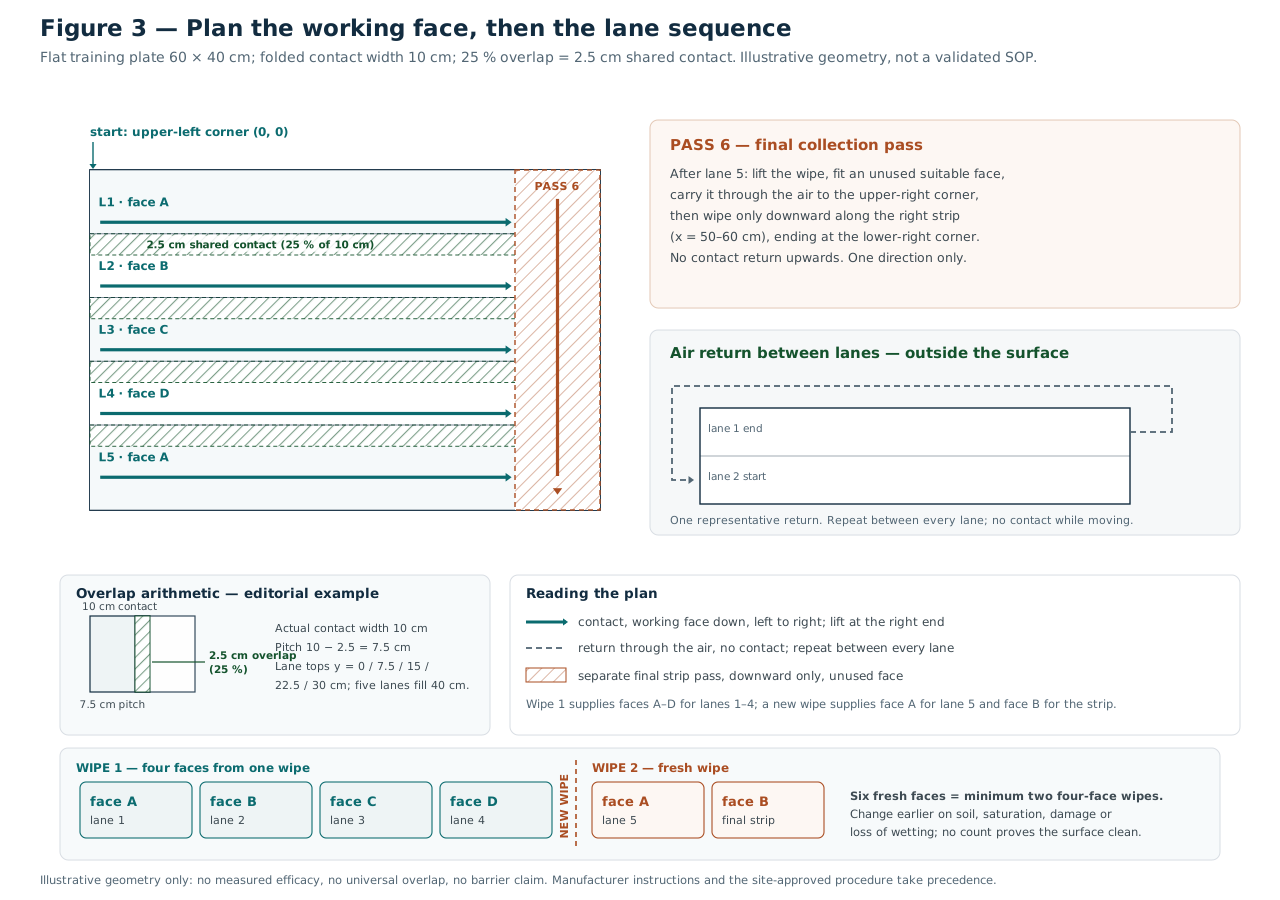
The lane approach is an observation framework, not evidence that straight lanes are biologically superior. A study of a biosafety-cabinet assessment system used visual tracking, thermal imaging and pressure sensing to distinguish sprayed, wiped and untreated regions, and tested zigzag wiping under controlled conditions [5]. That work supports objective observation of coverage and mechanical engagement; it does not establish a universal lane width, overlap, pressure or speed for pharmaceutical operations.
Plan the working face before the wipe touches the surface
A fold-and-lane pattern for flat, non-sterile surfaces, with the arithmetic an operator can check.
On a flat, non-sterile training surface, plan the working faces and lane sequence before contact. This reduces avoidable contact returns and makes face changes observable. Decide how many clean working faces a job needs, then lay out overlapping lanes that end with one separate collection pass.
Work left to right, lift at each right-hand end, return through the air, start the next lane at the same edge, and use a fresh face per lane. Finish with one downward pass over the last strip using an unused face, then check the strip, the lane ends and the general surface — not only the starting point.
Why face and path control matter
Mechanical action and wetting help detach soil, and fabric can collect it; a used face can also transfer material to another location. A return stroke in contact or continued use of an unsuitable face can therefore spread contamination. Gravity and drainage can affect vertical surfaces, but top-to-bottom is not a substitute for a clean-to-dirty assessment. For this horizontal training example, direction comes from the planned lane sequence, not gravity. Plan contact to avoid unnecessary returns and confirm removal and transfer locally; no fixed pass count proves a surface clean.
Worked example: a 60 × 40 cm training plate
Take a flat, non-sterile stainless training plate 60 cm wide (x) by 40 cm high (y) and a folded wipe with an actual contact width of 10 cm. That 10 cm is hypothetical: it is the folded width held against the surface, not the unfolded sheet. Measure your own; the arithmetic only holds for the width you use. The plate size, contact width and pitch are an editorial arithmetic example, not validated settings.
At 25% overlap the pitch is 10 − 2.5 = 7.5 cm, so lane top edges fall at y = 0, 7.5, 15, 22.5 and 30 cm. Five 10 cm lanes cover the full 40 cm height. Each runs from x = 0 to x = 60 cm, and the first starts at the upper-left corner of the whole surface, so it includes the left edge.
For this 25% example the count is five lanes and six faces, including the strip. Recompute whenever the measured contact width, the chosen overlap, the edge handling or the geometry changes: at 30% the same arithmetic gives six lanes and seven faces including the strip, and two four-face wipes remain the minimum, provided the site's earlier-change triggers still apply. Round the lane count up, and treat a setting whose last lane would run past the edge as a planning decision that needs its own rule. In the figure, arrows mark direction only; every lane runs to the right-hand edge at x = 60 cm.
At each right-hand endpoint, lift the wipe clear, return through the air, and start the next lane at x = 0; nothing in the return is in contact. Dragging back along the lane undoes the pattern, however carefully the lanes were marked.
A separate final pass covers the rightmost strip, x = 50 to 60 cm, downward from y = 0 to 40, ending at the lower-right corner, with an unused face and no return in contact. Every lane is lifted at that right edge, so the lane endpoints and the band they leave sit together along the right boundary. Giving that band its own single-direction pass with an unused face is a practice rationale: it avoids an in-contact return across the plate, but it is not a measured collection or removal step, it can itself transfer residue, and it builds load on the face that performs it. The downward direction follows the planned lane sequence, not gravity on a horizontal plate. Measure removal and transfer at the strip and at the lane endpoints in the local matrix.
Getting four faces from one wipe
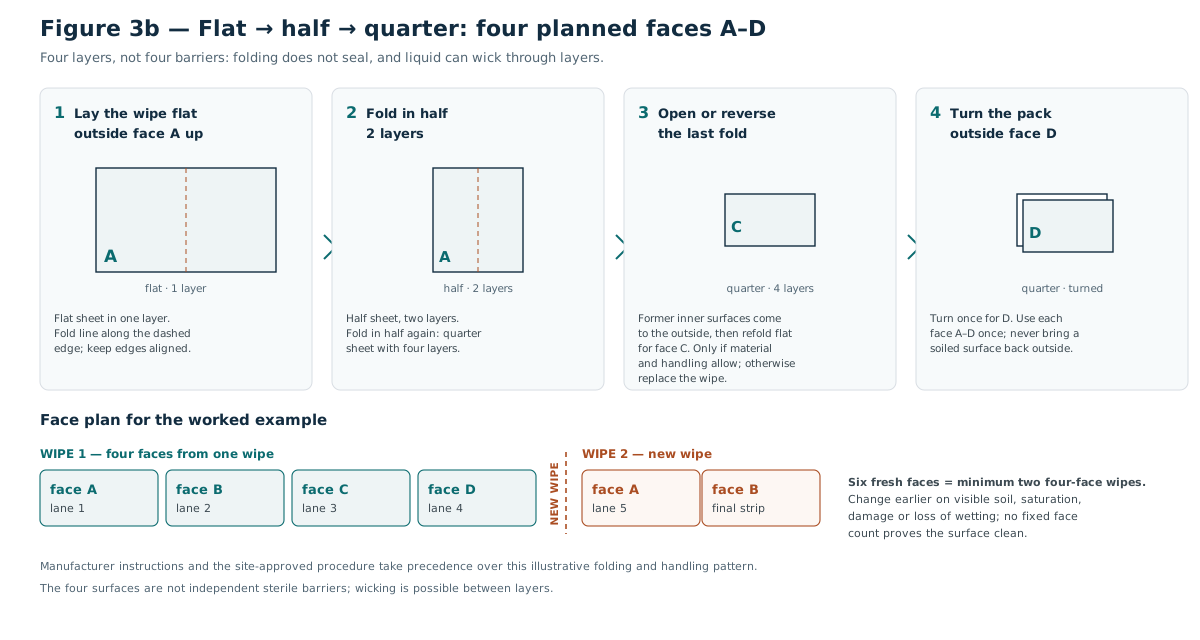
Start with a compatible wipe lying flat. Fold it in half, then in half again: four layers, with the two outside surfaces as faces A and B. Use A, then turn the whole folded pack to expose B without unfolding. To reach C and D, open or reverse the final fold and refold so the previously inner surfaces become the outside, then turn the pack again for D.
Never refold so that soiled material returns to the outside. Where geometry or material will not give a clean, unused outside face, replace the wipe rather than improvise. Two limits belong with the sequence: four planned faces is a convention for this example, not four independent sterile barriers — folding does not seal, and liquid can wick through layers. And one fresh face per lane is a rule for this exercise, not proof that another surface needs the same count.
Precedence: where the wipe manufacturer's instructions or the site-approved procedure specify a different fold, number of working faces, contact pattern or change interval, follow those instructions and that procedure. This folding and handling pattern is an illustrative training proposal; it does not override a manufacturer's instruction or an approved site procedure.
How many wipes
The example needs six fresh faces: A to D for lanes 1 to 4 with the first wipe, then a second wipe with face A for lane 5 and face B for the final strip. That is a minimum of two four-face wipes, with spares staged. Use that B face only if handling has left it suitable; otherwise take a new wipe. Change earlier, not at the planned count, on visible soil, saturation, damage, loss of the wetting the agent method requires, or a move to another zone. Contact time follows the approved agent method; this module sets none.
Overlap: start near 25%, plan within 15–30%
Overlap is a percentage of the actual contact width, not of the plate. The proposed operating range is 15–30%, with roughly 25% as the training target. A range is honest about what is known: less overlap gives less margin for changes in contact width or lane alignment; more increases repeated contact and, under a one-face-per-lane plan, may increase face use, and the balance depends on roughness, soil load and wipe geometry. This is an editorial starting proposal — not a qualified optimum, not prescribed by Annex 1, and not qualified by screening values such as 10, 25 or 50%.
State markers and removable tape are for a separate observational training run only. Remove them before a controlled efficacy or transfer trial unless their influence on the result has been assessed; a marker-altered test surface is not accepted as efficacy proof. Markers are a training aid, not a technique for production areas.
What the local trials must show
Confirm the pattern on your surface before adopting it. Endpoints: removal of the target residue or organism, transfer to adjacent areas, the lane ends and the final strip, and residue left on the plate as measured by your method. Controls: analytical recovery, a blank, a positive control, and material compatibility of wipe, agent and surface. The site — not this document — approves limits, replicate numbers and owners.
Cross the 15%, 25% and 30% overlap settings with the worst cases that apply to you: heaviest soil load, roughest and smoothest surfaces, edges and corners, and the longest realistic time between wetting and wiping. Pass or fail is read against the pre-agreed limit with controls acceptable; failed controls make the run inconclusive and it must be repeated, not counted as a pass. Observe the operator too: a pattern run with a contact return stroke is not the pattern that was designed.
Local confirmation matrix
Use this matrix in the local trial record. The site sets the criterion, the replicate number, the owner and the decision; no value in this table is a qualified limit. Approved 10 %, 25 % or 50 % screening values are not a qualification of this 15–30 % range.
| Trial setting | Controls and endpoints | Site-approved criterion and replicates | Owner / record / decision |
|---|---|---|---|
| Lower boundary 15 % overlap | Recovery control, blank, positive control; removal and transfer at lane seams | ||
| Target 25 % overlap | Same controls; removal, transfer at overlaps and lane ends | ||
| Upper boundary 30 % overlap | Same controls; repeated contact and face-use count recorded | ||
| Final strip pass and right-hand lane ends | Recovery control, blank, positive control; removal and transfer at the strip and at the lane ends | ||
| Worst case: high soil load, rough surface, edges and corners | Worst-case soil and finish; edge and corner endpoints assessed separately | ||
| Minimum approved wetness and longest approved delay between wetting and wiping | Wetness indicator, timing record, removal endpoint | ||
| Replicate operator and handling variation | More than one trained operator; observed face changes and returns |
Trainer checklist and parameters
- Measure the folded contact width; never the unfolded size.
- Compute pitch as contact width minus planned overlap; mark lane edges on the training plate only.
- Watch every right-hand endpoint for lift, air return and a fresh start at the left edge.
- Confirm A, B, C and D are exposed without returning soil to the outside.
- Count faces against lanes before starting; stage two wipes plus spares.
- Watch the final strip: downward, unused face, no return in contact.
- Check strip, lane ends and general surface after the run.
| Parameter | Starting proposal | Evidence status | Local owner | Record |
|---|---|---|---|---|
| Contact width | Measured on the folded wipe | Physical measurement | Trainer | Training log |
| Overlap | 15–30%, target ~25% | Editorial proposal; not a qualified optimum | QA / validation | Trial protocol |
| Pitch | Contact width − overlap | Arithmetic consequence | Trainer | Worksheet |
| Faces per wipe | Four planned, A–D | Convention; not sterile barriers | Trainer | Observation record |
| Wipe change | After planned faces or earlier trigger | Practice rationale | QA | Batch record |
| Contact time | Approved agent method | Method-specific | QA | Agent SOP |
| Pass/fail limits | Set by the site before the trial | Site decision | QA and laboratory | Validation report |
Evidence and derivation
Le et al. (2013) [10] compared cleaning movements on a stainless-steel plate and reported that redistributed contamination was 2.1–53.9% of the total quantity on the plate, with residue at the original deposit between 1.0 and >15% of the initial deposit; the two percentages have different denominators and the appraisal here is abstract-only. That study does not test folding, face count, overlap settings or a final strip pass, and its figures are not removal efficiency. The pitch, the lane edges, the lane count and the face count above are arithmetic consequences of the stated contact width and overlap, not literature values, and nothing was re-measured here.
Practice rationale
Overlapping lanes with a fresh face per lane, plus a separate strip pass, reduce avoidable returns with a used face; any transfer at overlaps and endpoints still needs local measurement. The four-face fold is a handling convention that makes the face count auditable, not a barrier claim, and the four surfaces are not independent sterile barriers.
Editorial proposal for local development
The 15–30% range, the 25% target and the six-face count are starting points for local confirmation. They are not universal limits and do not extend to biosafety cabinets, isolators, airflow-sensitive areas or sterile contexts, which need procedures written for their own airflow and contamination-control requirements.
The test of this module is not whether the pattern looks orderly. It is whether another trained operator can reproduce the start, finish, lane boundaries, face changes and strip pass on your surface, and whether your local matrix shows removal and transfer behaving as your criterion requires. If it does not, the pattern is what changes, not the criterion.
S-patterns
An S-pattern can reduce abrupt direction changes and may be practical on broad, unobstructed surfaces. It can also conceal where the working edge of the wipe has travelled and can encourage a return over an already treated area. It is therefore useful only when the start, finish, lane boundaries and face changes remain unambiguous. The operator should not allow the wipe to leave the planned area and re-enter a critical zone without an explicit change rule.
Circular and back-and-forth motions
Circular or back-and-forth motions may be useful for a local feature, stubborn residue or a geometry that cannot be covered by straight lanes. Their risks are less predictable direction, repeated loading of the same wipe area, and movement of soil beyond the intended boundary. They should be reserved for a qualified feature-specific instruction, with a defined final direction that does not drag a loaded wipe across an already accepted area. Evidence from cytotoxic-surface testing shows that movement choice affected both residual platinum and the spread of contamination; the result demonstrates process dependence, not a universal winning motion [10].
Zone order and containment
“Cleaner to dirtier” can be a useful planning principle, but it is not absolute. The order must reflect product-contact criticality, containment, airflow, personnel safety, hazardous-material controls and the possibility that a product-contact area must be protected from a less critical but visibly cleaner-looking area. A contaminated or potentially contaminated wipe should not be used across a clean boundary simply because the next zone is physically adjacent. In a large-surface transfer model, the tested disinfectant wipes transferred spores across increasing surface areas and retained spores after use [12]. Local qualification should therefore define the maximum area per wipe, if any, by evidence rather than by a generic number.
Folding, face tracking and wipe exchange
Folding can create a simple visual system for separating used and unused portions of a wipe. It is an organisational aid, not a guarantee of independent clean faces. Liquid redistributes through the substrate; pressure can transmit soil across folds; corners may contact adjacent faces; and a face may be depleted or loaded before it appears visibly dirty. Material, wetting, soil and geometry determine whether a folded face remains fit for purpose.
A site instruction should identify the initial fold, the permitted contact surfaces, the face-tracking notation and the exchange rule. A training card may label faces with letters or a simple diagram. The operator should mark or mentally advance the face after a defined event: completion of a lane group, contact with a high-risk feature, visible loading, loss of wetness, breach of a boundary, or any event established during qualification. Folding must not be used to justify routine double-dipping, dirty-face reuse or continued work after the wipe has become a transfer risk.
The exchange rule should be conservative where transfer is consequential. In the C. difficile study, used wipes retained viable spores and all tested wipe categories produced some transfer, although the extent varied by product and surface area [12]. The relevant control is not “use all available faces”; it is “use only a face whose suitability is supported by the qualified process.” For hazardous medicinal products, the wipe and waste route must also be compatible with containment and exposure controls; wipe cleaning is not a substitute for a validated deactivation strategy.
A wipe used to clean is not automatically suitable for sampling. Sampling has a different objective: recover a defined analyte from a defined area with known extraction, recovery and analytical performance. A European interlaboratory study of hazardous-medicinal-product wipe sampling found analyte- and laboratory-dependent recovery limitations, particularly at low concentrations [24]. The cleaning wipe should therefore never be treated as the analytical sample unless the protocol explicitly defines and validates that approach.
Wetting, dosing and contact time
Wetting must be sufficient for the intended chemical and mechanical action without creating uncontrolled runoff, aerosol, overspray, pooling or loss of containment. The qualified instruction should specify the delivery mode, the acceptable wet appearance or equivalent in-process indicator, the time window for effective contact, and what happens if the surface dries prematurely. “More liquid” is not automatically better: excessive liquid can reduce friction, increase spread, damage materials or create residue and containment hazards.
The agent, wipe and surface should be qualified as one system. A review of disinfectant-impregnated wipes identifies interactions between textile substrate and active ingredient as a recurrent cause of performance failure [18]. In a study of QAC-containing wipes, viscose retained substantially more active ingredient than polypropylene under the tested conditions, and extractable active content correlated with biofilm performance; the authors also identified a sustainability trade-off between some thermoplastic substrates and biodegradability [16]. These findings do not establish a universal material ranking, but they do justify testing active availability after contact with the selected wipe.
Contact time belongs to the approved agent and intended claim, not to a generic wipe gesture. It must be reconciled with wetness, evaporation, soil load, temperature, surface material and the sequence that follows. A study of cell-processing surfaces found that ethanol wiping did not provide the same control across mycoplasma, virus and endotoxin endpoints; endotoxin remained a distinct problem, while the tested water and benzalkonium-chloride conditions also had different performance and variability [7]. Do not describe ethanol as generally sporicidal or depyrogenating. The BSC study [5] reported reduced colony recovery after combined ethanol application and pressure-based wiping, including some non-detects. The full text also reports residual colonies in some combined-treatment tests. These data do not separate removal, retention and inactivation sufficiently to establish a general sporicidal claim.
For product-contact equipment, detergent or disinfectant residues must be assessed against the product, the next process step and the material. The sequence may require a qualified rinse or removal step, but not every disinfected sterile surface should be indiscriminately rinsed with unqualified water. In sterile areas, the status and transfer controls for agents and wipes must be defined within the CCS and applicable procedures; a risk-based recommendation must not be presented as a universal Annex 1 requirement [1].
Qualified mechanics, materials and geometry
Pressure, speed, area and strokes
Pressure, speed, maximum area, stroke count and overlap are candidate critical process parameters, not universal constants. They should be established using a combination of recovery studies, transfer studies, material-compatibility testing, operator observation and, where useful, instrumented training. The sensor study [5] demonstrates that pressure and coverage can be recorded, but its authors explicitly note that their pressure threshold lacked a biological basis and that pressure distribution may vary with tool design. A recorded force is therefore an observation variable until its relationship with the relevant endpoint is demonstrated.
A qualification plan should test the intended operating range and plausible low-performance conditions: insufficient wetting, early drying, excessive loading, slow or fast movement, incomplete coverage, an operator with limited reach, awkward access and repeated use of a face. Annex 15 expects protocols to define critical parameters and acceptance criteria from process knowledge, to cover operating ranges or justified worst cases, and to use trained personnel [2]. The resulting values belong to the site, equipment family and agent system; they should not be copied into another SOP without a comparability assessment.
Wipe substrate and agent compatibility
Select the wipe for the combined requirements of fibre shedding, particle generation, liquid capacity, release, wet strength, extractables, residue, compatibility with the surface and containment of the target soil. Compatibility questions include:
- Does the substrate adsorb or deactivate the active ingredient?
- Does the agent extract dyes, binders or fibres?
- Does repeated use damage seals, elastomers, plastics, coatings or stainless steel?
- Does the wipe remain structurally intact when folded, pressed and discarded?
- Is the required sterile or bioburden status demonstrated for the intended use?
- Can the waste route safely contain hazardous material and residual agent?
The wipe should be evaluated with the actual agent and not only with water. The effect of formulation composition, nonwoven structure and wetting can be material-specific; the 2025 healthcare wet-wipe study further illustrates that antibacterial performance depends on interacting compositional factors rather than on a single label category [21]. Where the selected wipe is pre-impregnated, storage time, package opening, evaporation and liquid distribution should be part of the qualification envelope.
Geometry and cleanability
Smooth, impervious and unbroken surfaces are easier to clean than recesses, ledges, exposed threads, hinges, sharp transitions, porous materials or damaged coatings. Annex 1 explicitly links surface design to prevention of particle and microorganism accumulation and calls for materials that permit repeated application of cleaning, disinfectant and, where used, sporicidal agents [1]. A wipe plan should map the actual geometry: main field, perimeter, underside, joints, ports, handles, glove interfaces and inaccessible faces. If a feature cannot be reached without changing posture, tool or wipe orientation, it is a separate cleaning task and should not disappear inside a generic “wipe surface” instruction.
In containment settings, the operator must avoid actions that generate aerosols or uncontrolled splashes. Hazardous or highly potent materials require the approved engineering controls, PPE, agent delivery and waste pathway. Do not improvise neutralisers, atomise hazardous agents or spray directly onto equipment unless the approved risk assessment and equipment compatibility justify that method.
Training, qualification and human factors
Training should demonstrate the whole process, not merely the named pattern. The trainee should explain the objective, identify the surface and hazards, select the approved system, establish the start and finish points, maintain the planned path, change faces at the defined triggers, manage wetness and dispose of the wipe without crossing a clean boundary. Observation should record omissions and compensating behaviour, not only completion time.
A useful qualification exercise combines a standardised mock surface with the real tool, agent and PPE. Use a visual coverage aid or tracer only as a training indicator, not as proof of chemical or microbiological efficacy. Where instrumentation is available, record coverage and pressure to support feedback, while keeping the endpoint distinction clear: sensor output demonstrates a feature of the action; it does not independently prove removal, inactivation or depyrogenation [5]. Include operators of different stature, reach and experience, and assess awkward geometries and fatigue. Ergonomic controls may include repositioning the work, changing the tool, splitting the area, using a qualified extension or assigning a second operator; any change must be assessed for contamination and transfer consequences.
Qualification should have pre-defined criteria for coverage, wetness, face tracking, agent identity, contact-time compliance, material integrity, residue and the analytical or microbiological endpoint relevant to the objective. Annex 15 requires trained personnel, approved protocols, documented deviations and investigation of results that fail acceptance criteria [2]. A missed lane is not automatically equivalent to a failed chemical endpoint, but it is a process deviation requiring impact assessment. Conversely, a negative assay does not erase a documented failure to control transfer or a recovery method that was not shown fit for purpose.
The practical standard is repeatable, observable and qualified behaviour under real constraints—not a visually attractive pattern. No universal S-pattern, circular motion, overlap, pressure, speed, area, stroke count or folded-face count should be published as a substitute for site evidence. The defensible instruction is to define those variables locally, qualify their acceptable ranges, train operators against the approved process, and review the system when the agent, wipe, surface, geometry, equipment, containment condition or intended endpoint changes.
3 Critical synthesis of the evidence
The literature is best read as evidence about particular combinations of surface, soil, wipe, chemistry, execution and measurement—not as a competition to identify a universally best cloth or hand movement. A reduction measured on the original surface can arise through removal, inactivation or both. It can coexist with contamination in the used wipe or on a subsequent surface. A convincing interpretation therefore starts with the measured endpoint and the boundaries of the experimental system. The studies below are grouped by relevance and question rather than pooled into a common effect estimate. Different outcomes, challenges and methods do not support a defensible numerical meta-analysis of this selected corpus. [9,11,13,18]
Each study card identifies the setting, the main outcome, the practical meaning and the transfer limitation. “Full text available” describes the retrieved evidence access; it does not imply that this review reproduced the study, independently verified its raw data or assessed every supplementary file. “Abstract only” is a substantive restriction: details not reported in the accessible abstract are not supplied by inference. Bibliographic years below are journal years; online-first timing is noted where it affects interpretation. This matters for records published online before assignment to a later journal issue.
Instrumented observation of biosafety-cabinet wiping — Mizuno and colleagues, 2026
Setting and access: Biosafety-cabinet work surfaces and a sensor-supported assessment system; full text available. The study combines visual tracking, thermal observation and pressure sensing to make parts of a manual wiping operation observable. Its important contribution is not a universal pressure threshold but the possibility of distinguishing apparent procedural compliance from actual surface coverage and applied mechanical action. [5]
Finding and interpretation: The combined treatment produced the largest reduction in recovered colonies. Although the abstract refers to complete growth inhibition, full-text sections 3.2 and 3.4 and the discussion describe non-detects in some tests and residual colonies in others. The qualified summary is therefore reduced viable recovery with occasional non-detects, rather than consistent complete clearance. It must not be reformulated as proof that alcohol is intrinsically sporicidal or that a clean-looking surface contains no residual material. Nor does coverage sensing itself demonstrate chemical residue removal. [5]
Pharmaceutical relevance and limitation: The work is directly relevant to cell-processing and controlled workstations, especially operator observation and training. A sensor trace remains a process-execution record until linked to independently justified performance endpoints. Transferring sensor acceptance thresholds to another tool, surface or geometry requires qualification rather than visual similarity.
Cell-product changeover and residual proteins/DNA — Mizuno and colleagues, 2024
Setting and access: A cell-processing changeover model using stainless steel and culture-medium residues; full text available. The study evaluates residue-related questions rather than relying solely on the absence of viable cells. Wet and dried material behave differently, and the effects of cleaning depend on the residue endpoint. [6]
Finding and interpretation: Some cleaning approaches reduced residual proteins and DNA more effectively than others. Importantly, an undetectable cell count did not invariably mean that proteins and DNA had also disappeared. The authors also report limitations of alcohol wiping for the protein-containing system and describe protein immobilization. This is a warning against equating antimicrobial use with removal of complex biological soil, not a universal prohibition on alcohol in every qualified cleaning sequence. [6]
Pharmaceutical relevance and limitation: This is unusually relevant evidence for changeover after biological processing. Its results justify residue-specific development and challenge selection. They do not establish that water alone is a suitable universal cleaning agent, that a particular detergent sequence can be adopted without qualification or that the tested substrate represents every equipment material.
Different residual hazards in biosafety-cabinet changeover — Mizuno and colleagues, journal year 2025
Setting and access: Cell-processing cabinet changeover with microbiological and endotoxin-related outcomes; full text available. The paper appeared online in December 2024 and in a 2025 journal issue. [7]
Finding and interpretation: Performance differed according to the contaminant and measured endpoint. The authors’ observations do not support treating a familiar alcohol-wiping operation as sufficient evidence for all changeover hazards. Endotoxin control, in particular, cannot be inferred from the same evidence used to discuss viable organisms. [7]
Pharmaceutical relevance and limitation: The practical value lies in separating hazards and selecting the corresponding tests. It is not an operating recipe for hazardous biological challenges. Facilities should use appropriately qualified specialists and their own approved assessment strategy. A result from one cabinet-surface model is not a sterilization or depyrogenation claim for an installed isolator or manufacturing line.
Wipes on pharmaceutical vaccine-production materials — Rhodes and colleagues, 2022
Setting and access: A pharmaceutical-industry study of peroxide wipes on stainless steel and low-density polyethylene in vaccine-related matrices; abstract only. This is one of the most directly manufacturing-relevant papers in the selected corpus because the materials and residue matrices are linked to an actual pharmaceutical application. [8]
Finding and interpretation: The abstract reports satisfactory virucidal performance under the tested conditions. The endpoint concerns infectious activity, not a demonstration that every vaccine-matrix constituent or cleaning-agent residue was removed. The accessible information therefore supports a bounded statement about the tested wipe system rather than a general claim of complete chemical clearance. [8]
Pharmaceutical relevance and limitation: The study strengthens the case for representative materials and realistic matrices in qualification. Without the full text, this review does not independently appraise all controls, execution details, replication or sponsor-related limitations. No concentration, contact time or acceptance threshold is adopted as a general operating recommendation.
Detergent wipes: removal variability and subsequent transfer — Ramm and colleagues, 2015
Setting and access: Detergent-wipe comparisons using stainless steel and a staged removal/transfer assessment; abstract only. The central question is whether a wipe that removes contamination from the first surface can carry some of it to later surfaces. [9]
Finding and interpretation: The study reports appreciable variability in removal and repeated transfer to subsequent surfaces. The evidence demonstrates that acquisition by a wipe is not necessarily a terminal removal route. A lower result on the first surface should not be interpreted in isolation from what the used wipe can subsequently deposit. [9]
Pharmaceutical relevance and limitation: This is adjacent healthcare evidence, not direct GMP equipment validation. It nevertheless supplies a strong mechanistic rationale for planned wipe-exchange rules and transfer-sensitive qualification. It does not identify a universal maximum wiping area or establish that every detergent-only cleaning stage is unsuitable when followed by an appropriately qualified sequence.
Chemical decontamination and contamination spreading — Lê and colleagues, journal year 2013
Setting and access: Cytotoxic workplace cleaning on stainless steel, with platinum used as a chemical marker of carboplatin contamination; abstract only. The paper appeared online in 2012 and in the 2013 journal issue. A 2021 correction concerns the spelling of an author name. The study compares cleaning solutions and execution-related features while measuring residual chemical contamination. [10]
Finding and interpretation: The accessible abstract reports differences between cleaning agents and protocols, and movement-dependent spreading of contamination across the plate. This matters because disinfectant identity alone cannot predict chemical decontamination. Sampling only the original deposit location can miss redistribution. The study also shows why chemical evidence deserves its own place alongside microbial studies. [10]
Pharmaceutical relevance and limitation: The occupational and pharmacy setting differs from manufacturing equipment. Findings about a particular chemical marker, surface and protocol cannot establish a generic HPAPI cleaning recipe. Safety, containment and chemically appropriate analytical methods remain essential. No operational solvent volume or delivery technique from this abstract is proposed for direct site adoption.
The test method changes the answer — Jacobshagen and colleagues, 2020
Setting and access: Comparison of the Wiperator approach associated with ASTM E2967-15 and the EN 16615 four-field test; full text available. The paper examines disinfectant-wipe performance using methods with different execution characteristics and surfaces. [11]
Finding and interpretation: The reported outcomes differed between the test systems, and the wipe itself influenced performance. More controlled mechanical execution and greater resemblance to a particular manual-use situation are not interchangeable attributes. Consequently, a result from one method should not be substituted for a result from another merely because both contain the word “wiping.” [11]
Pharmaceutical relevance and limitation: This is methodological evidence for specifying the assessment system and its relevance to intended use. It does not establish conformance with the current licensed edition of either standard, which this review has not independently obtained and assessed. Manufacturer efficacy evidence still needs a documented bridge to the site’s surfaces, soils, operators and cleaning claim.
Transfer by disinfectant wipes with no sporicidal claim — Nkemngong and colleagues, 2020
Setting and access: Healthcare-surface contamination and transfer during use of pre-wetted disinfectant wipes; full text available. The tested products were not presented as having a sporicidal claim. [12]
Finding and interpretation: The study reports transfer of spores from contaminated to initially uncontaminated surfaces during the wiping process. The important inference is that a wipe’s disinfectant classification does not guarantee that all acquired material is rendered harmless before another contact. It is particularly misleading to infer sporicidal control simply because the product has useful activity against other organism classes. [12]
Pharmaceutical relevance and limitation: The work supports explicit transfer controls and organism-appropriate evidence within a contamination-control strategy. Its healthcare model cannot define a general pharmaceutical exchange frequency or rank all products within a chemistry class. The label claim, tested formulation and intended-use conditions remain distinct from class-level assumptions.
Separating inactivation, removal and transfer — Cutts and colleagues, 2020
Setting and access: Laboratory assessment designed to separate several contributions to wipe performance using infectious-virus endpoints; full text available. The value for this review is the analytical separation of outcomes rather than any procedure for handling the challenge organisms. [13]
Finding and interpretation: The study distinguishes removal from the original surface, transfer to a second surface and virus inactivation. These measurements address different failure modes. Reporting only the original-surface result can conceal whether the process achieves inactivation, relocation or a mixture. [13]
Pharmaceutical relevance and limitation: The experimental setting and challenge materials are not a routine pharmaceutical-cleaning model. Transfer is therefore conceptual and methodological: define the intended claim and include the relevant compartments in the qualification design. No high-hazard biological testing protocol or operational challenge parameters are reproduced here.
Pre-impregnated wipes and carrier decontamination — Cutts and colleagues, 2021
Setting and access: Experimental stainless-steel carrier assessments of pre-impregnated wipes, including secondary-surface transfer questions; full text available. This is adjacent laboratory evidence, not an installed manufacturing-equipment study. [14]
Finding and interpretation: The reported findings distinguish a wipe that relocates contamination from a wipe system that also controls infectious activity under the tested conditions. They reinforce that physical removal and antimicrobial action should not be collapsed into an undefined claim of “cleaning efficacy.” Used-wipe behaviour remains relevant even when the original surface improves. [14]
Pharmaceutical relevance and limitation: The appropriate lesson is to evaluate the actual system, including the secondary-contact route. The results are not a cross-organism efficacy guarantee, a universal wipe-change rule or a basis for importing laboratory challenge conditions into a manufacturing SOP.
Mechanical wiping as part of a disinfectant system — Sloan and colleagues, 2022
Setting and access: Laboratory surface-disinfection work comparing liquid exposure with wiping and examining subsequent transfer; full text available. The study’s relevance is the contribution of mechanical action within a chemical treatment system. [15]
Finding and interpretation: Outcomes varied with the tested formulation and application approach. Mechanical wiping could improve performance, but the findings do not justify assuming that every disinfectant becomes effective simply by adding friction. Transfer outcomes also differed among the evaluated systems. [15]
Pharmaceutical relevance and limitation: These findings support testing application as part of performance rather than treating it as a trivial delivery step. The study does not compare all practical stroke patterns, establish a universal contact-time shortcut or demonstrate removal of pharmaceutical chemical residues. Product instructions and qualified wet-contact conditions cannot be replaced by the fastest favourable result from a different laboratory system.
Wipe materials and active-ingredient availability — Pascoe and colleagues, 2022
Setting and access: Quaternary-ammonium formulations, wipe-material properties and dry-surface-biofilm performance; abstract only. The work links recovered active-ingredient content to material interactions and antimicrobial outcome. [16]
Finding and interpretation: The accessible abstract reports substantial active-ingredient depletion in some material extracts and differences in biofilm-related performance. This is evidence that the concentration of the bulk liquid is not automatically the same as the chemically available dose delivered from a stored, saturated wipe. [16]
Pharmaceutical relevance and limitation: The practical inference is to qualify the wipe and chemistry together, including relevant storage and delivery conditions. The observed ranking cannot be converted into “all viscose is unsuitable” or “all polypropylene is superior.” Formulation, construction, loading and intended use must remain visible. Environmental advantages of a material do not remove the need for performance evidence.
Commercial and prepared wipes in a four-field assessment — Tyski and colleagues, 2021
Setting and access: An EN 16615-related assessment on homogeneous polymer surfaces, comparing selected commercial wipes and wipes prepared using corresponding disinfectant liquids; full text available. [17]
Finding and interpretation: The assessed products differed in performance, and prepared and commercial wipe formats were not uniformly equivalent. The study illustrates the importance of the complete product/application system, rather than demonstrating that locally prepared wipes are always better. [17]
Pharmaceutical relevance and limitation: Preparing wipes at a pharmaceutical site introduces additional controls over preparation, concentration, container, saturation, hold time, contamination and traceability. A favourable experimental comparison does not itself qualify such a preparation process or justify substituting a site-prepared system for an approved sterile product.
Carrier platforms that measure transfer — Zargar and Sattar, 2023
Setting and access: A high-touch-surface carrier platform designed to assess removal, inactivation and transfer; abstract only. The design includes assessment of a later surface after use of the wipe. [19]
Finding and interpretation: The tested systems differed in viability reduction and transfer behaviour. Its most general contribution is not a chemistry league table but a design principle: an initially clean receiving surface can reveal a failure mode that a single-surface before/after measurement misses. [19]
Pharmaceutical relevance and limitation: This supports transfer-sensitive study designs where reuse or movement between zones is foreseeable. The platform is not automatically representative of equipment joints, vertical panels, glove contact or complex geometry. Its accessible abstract does not permit a complete independent appraisal of the method’s robustness.
Multilaboratory evaluation of a wipe-specific test — Sattar and colleagues, 2015
Setting and access: Evaluation of a wipe-specific ASTM test approach by independent laboratories; abstract only. Both original-surface reduction and transfer are considered. [20]
Finding and interpretation: Products could achieve substantial original-surface reductions without uniformly preventing transfer. The distinction is important even when reduction values appear impressive: improvement of one endpoint does not establish control of a second endpoint. [20]
Pharmaceutical relevance and limitation: Multilaboratory work contributes to confidence in method assessment, but it does not eliminate intended-use differences. This paper is evidence about the assessed method and products, not certification of the site’s process or the current edition of the standard.
Compositional factors in healthcare wet wipes — Angulo-Pineda and colleagues, 2025
Setting and access: Research on compositional factors and antibacterial performance of healthcare wet-wipe products; full text available. Its subject is the relationship between product composition, liquid release, test conditions and observed antibacterial efficacy. It was supported by a UKRI and Saraco Industries knowledge-transfer partnership; the authors state that the company had no role in the study design, analysis, interpretation, writing or submission decision. [21]
Finding and interpretation: For this synthesis, the justified use is as formulation-level evidence within a broader material/chemistry discussion. A product is not defined solely by its named active ingredient or the fact that it is supplied wet. The study should be consulted in full when evaluating a formulation-specific proposition rather than converted into an unsupported general ranking. [21]
Pharmaceutical relevance and limitation: Healthcare antibacterial endpoints do not establish chemical residue clearance, endotoxin control or compatibility with every GMP material. Any proposed substitution needs the site’s change-control and qualification rationale.
Sanitizers with and without wiping in a food-surface model — Faircloth and colleagues, 2022
Setting and access: Food-associated surface sanitization on Formica, including an assessment of the contribution of wiping; full text available. [22]
Finding and interpretation: The study reports variability among sanitizers and an important contribution from wiping. Human norovirus outcomes used RNase RT-qPCR, whereas Tulane virus was assessed with an infectivity assay. A reduction in the human norovirus signal must therefore retain that molecular endpoint; it is not a direct human-norovirus infectivity measurement. [22]
Pharmaceutical relevance and limitation: Food-contact material, soil, organism and sanitizer-use conditions are not pharmaceutical equipment equivalence. No food-sector “no-rinse” designation should be imported as proof of acceptable pharmaceutical residues. This is mechanistic supporting evidence, not a GMP acceptance criterion.
Surface and used-wipe measurements with coronavirus surrogates — Yan and colleagues, 2025
Setting and access: Hard and soft nonporous surfaces, wipe systems and separate measurements on surfaces and used wipes; full text available. The work also compares manual and mechanical execution within the assessed system. [23]
Finding and interpretation: Material and treatment affected the distribution and infectious activity of recovered material. The study reports no significant difference between manual and mechanical wiping in the tested comparison, but that is not an equivalence demonstration for every manual process. A nonsignificant difference in one design cannot establish independence from operator behaviour or prove universal reproducibility. [23]
Pharmaceutical relevance and limitation: The paper usefully illustrates joint surface/wipe assessment and the need to preserve substrate identity. Its virus-surrogate outcomes do not establish pharmaceutical-product removal or resolve the comparative merits of every hand-wiping pattern.
Interlaboratory surface-wipe sampling of hazardous medicines — van den Berg and colleagues, 2025
Setting and access: An interlaboratory comparison involving surface-wipe sampling and analysis of hazardous medicinal products; full text available. This is a measurement-system study, not a comparison of cleaning techniques. [24]
Finding and interpretation: The reported accuracy and recovery outcomes varied among analytes and laboratories, with particular challenges at some low levels. This is a warning that a reported surface concentration is mediated by collection, extraction and analytical performance. A low result cannot be interpreted independently of the method’s demonstrated capability. [24]
Pharmaceutical relevance and limitation: The relevance is strongest for chemical monitoring and sampling-method qualification. It cannot establish that the sampling wipe is suitable for cleaning or that the paper’s performance criteria are universal regulatory acceptance limits. A site’s residue decision must connect its own method performance to its own justified cleaning limit.
Wiping materials and dry-surface biofilm — Wesgate and Maillard, 2026
Setting and access: Food-safety surface models comparing wiping materials and sanitizer systems against different microbial states; abstract only. [25]
Finding and interpretation: Material choice influenced the assessed outcome, and dried planktonic material did not behave identically to dry-surface biofilm. A convenient challenge model can therefore overstate the relevance of a positive result if the real soil or microbial state is more difficult. [25]
Pharmaceutical relevance and limitation: The food-sector setting does not justify introducing the tested cloths, sponges or paper towels into a classified pharmaceutical environment. Nor does the observed material ranking establish suitability regarding fibres, extractables, sterility, chemical compatibility or containment. Its contribution is a challenge-selection and system-interaction warning.
Sampling optimisation for antineoplastic residues — Guichard and colleagues, journal year 2021
Setting and access: Optimisation of a chemical wipe-sampling procedure for multiple antineoplastic agents and application in a hospital pharmacy; abstract only. The paper appeared online in 2019 and in the 2021 journal issue. [27]
Finding and interpretation: Sampling device, collection liquid and desorption conditions influenced recovery. The abstract demonstrates that sampling is a method requiring development rather than a neutral act of touching a surface with a cloth. [27]
Pharmaceutical relevance and limitation: This contributes to analytical verification and recovery-study design. The successful sampling conditions must not be relabelled as an effective cleaning method or adopted as a universal solvent instruction. A recovery advantage for one analytical purpose may have no corresponding benefit for actual cleaning performance or operator safety.
What the reviews add—and what they cannot add
Song and colleagues’ hospital-focused review assembles the interacting roles of wipes, disinfectants, application methods, active-material interactions and wiping strategy. It helps organise the problem and identifies weaknesses in efficacy-test designs. It is a secondary synthesis, not another independent experiment to add to a count of successful cleaning trials. Its relevance to pharmaceutical practice is conceptual and must be checked against the actual primary evidence and GMP context. [18]
Okusanya and colleagues’ systematic review addresses community surface disinfection and spraying versus wiping for COVID-19 prevention. Importantly, the review reports no studies directly comparing spraying with wiping and no human-participant studies in its included evidence. It cannot support a definitive clinical superiority claim for either application approach. Its search period also precedes several papers included in the present narrative review, so it is neither a current comprehensive summary of all wipe-cleaning research nor a manufacturing-specific evidence assessment. [26]
Independence and commercial relationships
The selected papers do not form 23 independent demonstrations of one process. Two are reviews, several share investigators and assessment platforms, and the 2020 and 2021 Cutts papers have overlapping authors and related experimental systems [13,14,18,26]. They should not be counted as independent votes for a product or pooled without checking data provenance.
Commercial relationships can influence the questions and products selected without invalidating the measurements. For example, the Cutts papers disclose company employment, funding and paid consultancy, and the Angulo-Pineda study discloses a knowledge-transfer partnership co-funded by industry [13,14,21]. These factors require attention when weighing formulation comparisons. This narrative review has not performed a formal risk-of-bias assessment or verified raw datasets. Its conclusion concerns recurring failure modes and questions for qualification, rather than a market ranking.
Reading across studies without erasing their boundaries
The recurrent conclusions are stronger at the level of principles than operating numbers. Wipe and chemistry form an interacting system; transfer can persist despite an improved initial surface; chemical residues and viable-organism outcomes are not interchangeable; the assessed method and intended-use context influence the answer. Those are defensible cross-study themes, not pooled estimates of how much better a particular technique performs. [9,10,11]
Confidence also differs by claim. Direct manufacturing or cell-process relevance improves contextual fit, but does not automatically make a small laboratory model more representative than all adjacent evidence. Conversely, careful healthcare or analytical-method research can identify important failure modes while remaining insufficient to validate manufacturing equipment. “Direct” and “high quality” are separate questions. This review deliberately does not assign a numerical quality score that would imply a formal risk-of-bias appraisal it has not performed.
Quantitative anchors: reported results without false pooling
The following values retain their original endpoint and denominator. They are study observations, not site acceptance limits, recommended exposure times or instructions for reproducing the experiments. Differences in organisms, substrates, analytical methods and products prevent a meaningful pooled efficacy estimate.
| Study and access | Reported quantitative observation | What the number does—and does not—mean |
|---|---|---|
| Ramm et al., 2015; abstract only [9] | Across seven detergent wipes, reported removal ranges were 0.24–3.25 log10 for S. aureus, 3.01–3.81 log10 for A. baumannii and 0.26–1.44 log10 for C. difficile spores. All wipes repeatedly transferred contamination to three consecutive surfaces. | The organism-specific ranges demonstrate variability, not a universal removal capability or a safe reuse rule. Reduction at the first surface is distinct from transfer control. |
| Lê et al., journal year 2013; abstract only [10] | Residue at the original deposit location was 1.0 to >15% of the initial deposit. Redistributed contamination represented 2.1–53.9% of the total quantity on the plate. | These percentages have different denominators. They must not be added together or described as equivalent percentage removal. The chemical marker was platinum associated with carboplatin. |
| Jacobshagen et al., 2020; full text [11] | The two test methods differed significantly for S. aureus (p = 0.001) and P. aeruginosa (p = 0.025) in the reported comparisons. | Statistical significance is not an effect size, proof that a method is universally superior, or evidence of pharmaceutical intended-use equivalence. |
| Pascoe et al., 2022; abstract only [16] | Extract from one viscose-based commercial product contained 89% less DDAC than the impregnation solution. In the separate material comparison, nearly 70% depletion was reported for viscose extracts and 25% for polypropylene extracts after storage. | These are product/material-specific changes in recovered active ingredient, not percentages of surface cleaning or class-wide material performance. They support assessing the wipe–formulation interaction. |
| Sattar et al., 2015; abstract only [20] | Three laboratories assessed five commercial wipe products. All achieved >4 log10 reductions in the assessed bacterial endpoint, but only one prevented transfer to another surface. | A large initial-surface reduction does not establish transfer control. This is evidence about the assessed products and test method, not site validation. |
| van den Berg et al., 2025; full text [24] | Four laboratories were involved. Of 80 samples, 69 met the study’s accuracy target and 70 met its recovery target, reported as 86% and 88%. The respective targets were 70–130% and 50–130%. | These are the study’s analytical-performance targets, not universal GMP cleaning limits. Accuracy and recovery are different metrics, and low-level and analyte-specific failures remain relevant. |
| Guichard et al., journal year 2021; abstract only [27] | The two polyester sampling swabs had reported mean desorption recoveries of 90% and 95% across the assessed compounds. | Desorption performance must not be relabelled as whole-procedure surface recovery or cleaning efficacy. The accessible abstract does not justify a universal collection or solvent specification. |
Research gaps and a practical evidence agenda
The reviewed evidence does not establish a universally superior hand-wiping pattern for pharmaceutical manufacturing. In particular, a familiar recommendation to wipe in overlapping unidirectional lanes should be distinguished from a demonstrated, broadly generalisable advantage over every S-pattern, circular motion or locally constrained technique. Such recommendations can be sensible process-control proposals without being comparative clinical or manufacturing evidence. The appropriate claim is that the site’s chosen method has a documented rationale and demonstrated performance within its qualified boundaries—not that the literature has selected one pattern for all sites.
A useful research programme would compare practical patterns while separating coverage, material removal, transfer and operator execution. It should include relevant surface geometries, wetness changes, representative residues, wipe exchange and training effects rather than studying a stroke pattern in isolation. The study design should be proportionate to risk and developed by competent specialists. It should not copy hazardous biological challenge procedures simply because they are reported in the literature.
Chemical cleaning deserves more direct attention. Much wipe literature is about microbial disinfection; fewer selected papers examine pharmaceutical-type chemical residue redistribution and clearance. Future work should connect sampling-method capability, whole-zone residue accounting and cleaning-agent clearance, including the possibility that an apparently successful antimicrobial step complicates later removal of biological or chemical soil. The distinction between a cleaning wipe and a sampling wipe should remain explicit throughout.
Operator variability is another open question. Sensors, observation and controlled rigs can help characterise execution, but they need an evidence bridge to meaningful surface outcomes. Studies should report failures and deviations as well as central tendencies, distinguish individual learning from robust process performance, and assess relevant operators and geometries. Automated wiping is not a substitute for this bridge when the routine process is manual.
Finally, reporting should make surface and soil identity, product system, access limitations, intended claim, method recovery, detection or quantification limitations and secondary transfer visible. Publication of only the most favourable reduction value is insufficient for a defensible manufacturing decision. The site protocol and the literature-extraction template supplied with this package are designed to preserve those distinctions rather than erase them.
4 Designing qualification and validation
A manual wipe process is not qualified by showing that a wipe looks wet or that one organism is no longer recovered. The qualification question must state the surface, contaminant, process purpose, wipe system, operator action, sampling method and decision rule. “Cleaning” may mean removal of an API, protein, DNA, detergent or visible soil; “disinfection” may mean reduction or inactivation of specified microorganisms; deactivation and depyrogenation are separate objectives. A single result cannot answer all of these questions.
For product-contact equipment, the validation package should establish documented evidence that the approved cleaning process reproducibly removes previous product and cleaning-agent residues below scientifically justified limits. Health Canada also places product-contact cleaning within quality risk management and asks sites to consider non-contact parts where residue could migrate [3]. Annex 15 similarly requires a justified, documented risk basis for the scope and extent of qualification and validation, with predefined parameters and acceptance criteria [2]. The following study design is a development framework; site approval and execution records remain separate.
The first protocol page should therefore identify:
- the intended use: product-contact cleaning, environmental cleaning, disinfection, deactivation or another defined purpose;
- the target residues and hazards, including API, excipient, protein, DNA, cleaning agent, viable organisms, spores or endotoxin;
- the equipment family, surface materials, geometry and inaccessible or difficult-to-clean locations;
- the complete wipe system: substrate, formulation or solution, packaging, wetting state, storage and exchange rules;
- the critical process parameters to control or observe, without importing universal pressure, speed, overlap, area or stroke-count values;
- the sampling and analytical methods, their recovery, neutralization, specificity and quantification limits;
- the acceptance criteria approved before execution; and
- the change-control and ongoing-monitoring route that will preserve the validated state.
A cleaning-validation study must not be confused with qualification of a wipe-sampling method. The former tests whether the cleaning process achieves its purpose. The latter tests whether the sampling device, extraction and analytical method can recover and measure what remains. Both are necessary, but they answer different questions [2,24,27].
Risk assessment and representative scope
For EU shared-facility risk assessment, the direct toxicological reference is the EMA HBEL guideline EMA/CHMP/CVMP/SWP/169430/2012 [28]. It describes deriving substance-specific safe exposure thresholds, including PDE, from a scientific toxicological assessment. A PDE is an exposure value, not a surface limit: the site must justify the bridge to product-pair carryover and equipment or sample limits, including the next product and equipment train. The Canadian guide remains a separate jurisdictional source [3].
Annex 1 and Annex 15 have overlapping applications. Annex 1 includes equipment cleaning and contamination control in sterile manufacture; Annex 15 addresses qualification and validation, with section 10 specifically addressing product-contact cleaning. A surface label alone does not determine all applicable requirements.
Use a documented risk assessment to rank products, surfaces and operations. Relevant factors include residue potency or health-based exposure limit (HBEL), solubility, physical form, adhesion, drying or hold time, toxicity, cleanability, microbial or endotoxin hazard, surface roughness, joints, seals, welds, dead legs, access, operator exposure and the consequence of transfer to the next product or zone. Health Canada allows product-family and equipment-grouping approaches only where the scientific rationale, represented items and equivalence of equipment and cleaning processes are documented [3]. Annex 15 describes worst case as conditions within the approved procedure that pose the greatest chance of failure, not necessarily conditions that must fail [2].
Select representative and worst-case materials rather than a convenient coupon alone. A defensible set may include the actual stainless-steel grade, polymer or elastomer, coated surface, gasket, weld, crevice and instrument interface used in the equipment. Include a smooth, accessible area and a deliberately difficult location when geometry is a known risk. If coupons replace equipment, document why their material, finish, soil loading, drying behaviour and recovery are representative. A result on polished stainless steel cannot silently qualify a porous, damaged or chemically different material.
Define soil and hold times as study variables. The worst case may be a low-solubility residue, a dried film, a protein-rich or mixed soil, the end of a campaign, the maximum dirty hold time, or the maximum proposed clean hold time before use. Annex 15 specifically calls for consideration of the time between manufacture and cleaning and between cleaning and use, campaign length, and the influence of operators and procedural detail [2]. Do not manufacture an artificial worst case by adding unrepresentative quantities or allowing uncontrolled ageing; record preparation, storage, environmental conditions and the rationale.
Operators are part of the process. Include trained operators who represent normal use, not only the most skilled investigator. Observe the actual sequence, wetting, fold or side changes, direction, zone transitions, wipe exchanges, tool access and discard behaviour. Training may standardise the approved process, but it cannot turn an unqualified pressure or pattern into a universal requirement. The study should measure whether the procedure is sufficiently clear and robust, not reward undocumented improvisation.
A staged study design
Phase 1: process definition and feasibility
Begin with a written process map and a failure-mode assessment. Identify where chemistry, mechanical action, surface, contamination state and operator action can interact. Define controls for wetting and contact time. Confirm that the wipe releases a usable amount of liquid, does not shed unacceptable particles or fibres, and is compatible with the surface and agent. Check that the proposed sequence controls movement from dirty to clean areas and does not require routine double-dipping or reuse of a visibly or demonstrably contaminated face.
A factorial or fractional-factorial pilot can be appropriate when several variables are uncertain. Candidate factors might include wet versus dried soil, two representative materials, two wipe systems, two qualified application states, and two operators. The design should be risk-based and proportionate: it is not a licence to screen arbitrary off-label concentrations or contact times. The purpose is to identify influential factors and interactions, refine the process window and select confirmation conditions. Record all factors and levels before testing, including those that produce an apparently unfavourable result.
Phase 2: method and process qualification
Before confirmation, qualify the analytical methods and the sampling plan. Then execute the approved cleaning process at its intended operating conditions and justified worst-case boundaries. Use independent locations or witness surfaces where a destructive sample would otherwise prevent assessment of a critical area. A witness surface is not automatically representative; document its material, location, exposure, soil history and relation to the real equipment.
There is no universal “three runs” rule for a manual wipe process. Replicate number should be justified by the risk, expected variability, study design, number of operators, number of materials and strength of the decision required. Annex 15 states that the number of validation activities and samples should be risk-based and sufficient to demonstrate consistent performance [2]. A small pilot may support factor selection but not a broad claim of reproducibility. Conversely, a scientifically justified bracketing or representative-equipment strategy may avoid testing every equivalent item when equivalence is demonstrated [2,3].
Preset acceptance criteria should distinguish critical from supporting evidence. Examples of distinct criteria include a residue-specific result below the approved limit; an acceptable cleaning-agent result; visual cleanliness; a validated microbial or endotoxin criterion where relevant; acceptable recovery and control performance; and no unexplained transfer to a witness surface. Visual inspection is important but is not generally sufficient by itself for cleaning validation [2]. Do not retest repeatedly until the result passes: a failure is a deviation requiring investigation and a scientifically justified conclusion [2,3].
For API and other chemical residues, limits should follow the site’s toxicological evaluation and HBEL process, not an invented wipe-specific number. Health Canada describes PDE/TTC-type safe threshold values and expects the rationale for carryover limits to be documented [3]. Cleaning-agent residues require their own acceptance basis. Where direct analyte testing is infeasible, a surrogate such as TOC or conductivity may be justified only when its relationship to the residue and decision is established [2]. TOC is not a specific API measurement merely because it is convenient.
Phase 3: confirmation, transfer and lifecycle
The confirmation protocol should lock the process, materials, operators or operator strata, sampling map, methods, acceptance criteria and deviation rules. Include difficult locations and, where justified, a transfer challenge from a contaminated source to a clean witness surface. Transfer must be reported separately from removal: a low source-surface result does not prove that no residue or organism reached a subsequent surface [12-15,20].
A study that moves from coupons to equipment is a transfer, not a formality. Verify the actual surface finish, geometry, access, liquid delivery, wipe availability, waste route, operator posture and environmental controls. Confirm that the sampling method can reach the selected locations without altering the surface or contaminating the sample. Any difference from the qualified process is a change requiring assessment.
The lifecycle does not end with the report. Define routine verification or ongoing monitoring proportionate to risk, including visual checks, selected chemical or microbiological sampling, operator observations, trend review and periodic reassessment.
Annex 15 paragraph 10.15 addresses confirmation of manual-cleaning effectiveness at a justified frequency, and section 11 addresses change control [2]. Health Canada similarly describes ongoing monitoring, change control and requalification as phases of cleaning validation [3]. Reassess after a wipe supplier or substrate change, formulation or packaging change, agent concentration or contact-time change, equipment modification, surface damage, new product, new residue, new sampling laboratory, adverse trend or significant deviation.
5 Sampling and interpreting the result
Method suitability is part of the result
The sampling plan should define location, area, timing, device, extraction or desorption, transport, storage, blank controls, recovery correction policy and reporting units. Annex 15 requires recovery to be shown from all sampled product-contact materials with the methods used and states that sampling materials and methods should not influence the result [2]. The European interlaboratory study of hazardous medicinal-product wipe sampling illustrates why this matters: recovery and accuracy varied by compound and laboratory, with low concentrations presenting particular difficulty [24].
A cleaning wipe and a sampling wipe are different process components. A cleaning wipe is selected to wet, remove, retain or inactivate a target under the cleaning sequence. A sampling wipe is selected for recovery, extraction and measurement. The latter may require a defined swab or wipe material and solvent; evidence for a hospital-pharmacy sampling procedure using polyester devices and isopropanol 75% cannot be converted into a cleaning recommendation [27].
Recovery studies should cover each relevant material or a justified grouping, representative residue levels, the sampling area, desorption procedure and analyst or laboratory controls. Include blank wipes, solvent blanks, surface blanks, positive controls, matrix controls and, where biological methods are used, neutralizer-toxicity and neutralizer-efficacy controls. A disinfectant or detergent that remains active during culture can suppress recovery and create a false impression of cleaning or inactivation; Annex 15 paragraph 9.3 addresses sanitising-agent interference in cleanroom microbial surface methods; section 10 addresses cleaning validation [2]. Neutralization must be demonstrated for the specific agent and assay. For cytotoxic or highly potent compounds, any chemical quenching or deactivation step requires compound-specific validation.
For chemical assays, define specificity, selectivity, linearity or calibration model as applicable, accuracy, precision, stability, extraction efficiency, LOD and LOQ. For microbiology, define the organism or indicator, recovery method, detection limit, controls, incubation and the distinction between viable recovery and inactivation. PCR can indicate target nucleic acid; it does not establish viability or infectivity. Culture negativity is bounded by recovery and detection conditions. ATP and visual inspection are broad indicators, not substitutes for specific API, endotoxin or microbial methods. TOC reports total organic carbon under the method conditions and does not identify the contributing substances. Its suitability depends on residue response, recovery, background and the decision limit.
Censored results are not zero
Report “<LOQ” or “not detected under the validated method conditions,” not zero, when the result is below a limit of detection or quantification. Retain the numerical limit, sampled area, recovery basis and any censoring rule. Do not silently replace a censored value with zero in a mean, trend or mass balance. State whether the acceptance criterion is defined on the reported result, a recovery-corrected result, a confidence bound or another prespecified rule. If recovery is poor or variable, a non-detect may be an analytical limitation rather than evidence of absence [24].
Interpret visual cleanliness and chemistry together but do not make one a proxy for the other. A surface can look clean while carrying a potent residue; a visible film can be non-specific; a low TOC value can coexist with an unacceptable specific residue. Similarly, absence of recovered organisms after a disinfectant may reflect inactivation, removal to the wipe, transfer, incomplete recovery or residual antimicrobial activity. Studies comparing wiping methods demonstrate that automated and manual systems can produce different results, and that the wipe itself can materially affect performance [11,17]. Method selection therefore belongs in the protocol, not only in the final report.
Translate the method limit into the surface decision
For a chemical extract reported in ng/mL, a defined conversion is surface loading = C × V × D / (R × A), where C is the measured extract concentration, V is the extraction volume in mL, D is the explicitly unapplied dilution factor, R is the approved recovery fraction and A is the sampled area in cm². The result is ng/cm². If dilution or recovery is already included in the laboratory value, do not apply it again. The chosen basis and method reference must be recorded. A recovery estimate above 100% is not automatically impossible, but it needs an approved interpretation rather than an arbitrary correction policy.
For a result reported <LOQ, replace C by the numerical LOQ only to calculate the corresponding reporting boundary. Retain the < sign and the original result class. This boundary is not a measured concentration or a statistical confidence limit. A reporting boundary above the acceptance limit cannot demonstrate a result below that limit. A boundary at or below the limit can support review only if method suitability, controls and the prespecified censoring rule are satisfactory. The same distinction applies to <LOD using the numerical LOD.
Hypothetical calculation: C = 2 ng/mL, V = 10 mL, D = 2, R = 0.50 and A = 25 cm² gives 3.2 ng/cm². With the same conversion, LOQ = 0.5 ng/mL gives a reporting boundary of 0.8 ng/cm². These numbers are arithmetic examples only; they are not cleaning limits, target recoveries or recommended sampling conditions. T08 in the workbook implements this conversion and leaves final disposition to the responsible reviewer.
Hypothetical development case
The following is a procedural example only. It contains no experimental result and does not qualify any real site.
A site proposes a manual wipe process for a stainless-steel product-contact enclosure used after a protein-containing process. The risk review identifies three objectives: remove protein residue, control cleaning-agent residue and prevent transfer to an adjacent clean surface. The enclosure includes a smooth panel, a weld and a gasket interface. The dirty hold time may be short or extended, and two trained operators normally perform the task.
The team first rejects a generic “eight faces, fixed overlap and fixed pressure” instruction because those parameters have not been qualified. It maps the surface, identifies the gasket and weld as difficult locations, and selects a representative protein soil with documented preparation and two hold-time conditions. It compares two candidate wipe systems only after confirming compatibility with stainless steel and the cleaning agent. The protocol records wetting state, sequence, face exchange, discard rule and contact-time control as observed variables.
The pilot uses a risk-based factorial structure to examine soil state, material, wipe system and operator. The endpoint is not a single pass/fail number: it includes a specific protein method, cleaning-agent method, visual inspection, recovery controls and transfer sampling on the witness surface. The team defines before execution what constitutes a valid run, what invalidates a sample, how <LOQ values are reported and when a deviation is opened.
Suppose the pilot shows that one wipe system is compatible but releases less liquid at the gasket, while the other gives better access but leaves an unacceptable residue in a blank-material check. The procedural decision is to reject the second system for this application and to redesign the access step, not to average the results into a pass. Suppose an operator observation identifies inconsistent face exchange. The decision is to revise the instruction and retrain before confirmation, not to conceal the observation as operator error. Confirmation then uses the selected system, qualified sequence, representative operators, difficult locations and preset chemical and transfer criteria. Only after the report addresses all deviations and controls would the site decide whether the process is validated for the defined scope.
This case demonstrates the logic of qualification: define the target, expose interactions, control the method, investigate failures and state the boundary of the conclusion. It does not establish a concentration, contact time, wipe area, number of runs or acceptance limit for another site.
6 Investigating failures
| Observation | Possible interpretation | Required response | Do not conclude |
|---|---|---|---|
| Visual pass, chemical fail | Specific residue remains or visual check lacks sensitivity | Hold disposition; investigate chemistry, soil and recovery; revise process if needed | “Looks clean” means clean |
| Chemical <LOQ with poor recovery | Method may not recover the residue | Repeat method-development work with controls; report censoring | Residue is zero |
| Culture negative after disinfectant | Inactivation, removal or inhibition may contribute | Verify neutralization and recovery; separate cleaning from disinfection | Sterility or total removal |
| Low source result, witness positive | Redistribution or transfer occurred | Investigate direction, face exchange, wetness and zone sequence | Source reduction proves no transfer |
| Different operators diverge | Instruction or process window is not robust | Observe technique, clarify controls, retrain and reassess qualification | One operator is the universal reference |
| Wipe material changes performance | Adsorption, release, wetting or retention differs | Requalify the complete wipe-agent-surface system | Active ingredient alone predicts outcome |
| Failure only after long dirty hold | Drying or adhesion changes cleanability | Define hold-time control or qualify the longer condition | Short-hold data cover all holds |
| Sampling blanks or controls fail | Contamination, inhibition or analytical instability | Invalidate affected run as defined; investigate before retesting | A convenient result can be salvaged |
| Surface damage or geometry change | Access, retention or recovery may have changed | Raise change control; assess requalification and new sampling sites | Old validation automatically remains valid |
The companion toolkit should link the troubleshooting record to the templates for deviation investigation, sampling map/recovery and operator observation. Templates make the decision trail consistent; they do not replace scientific review or site approval.
7 Implementation and lifecycle
Sustainability should reduce waste without weakening contamination control. Optimise wipe size, packaging, liquid delivery, exchange rules, route planning and waste segregation only through a qualified change. A smaller wipe, longer reuse interval or reduced wetting may lower material consumption while increasing transfer, dry spots, residue or operator exposure. Wipe-material selection also has an efficacy and environmental dimension: adsorption and release can alter available active agent, while biodegradability and disposal requirements may differ [16]. Compare the complete controlled system, including packaging, transport, sterilisation where applicable, hazardous-waste treatment and failed-run burden. Never make an environmental claim from a single laboratory endpoint.
Final implementation checklist
- Define whether the activity is cleaning, disinfection, sanitization, deactivation or depyrogenation.
- Identify product-contact, non-contact, BSC/isolator and sterile-use boundaries.
- Document the target residue or organism and the intended decision.
- Complete a risk assessment for HBEL, cleanability, material, geometry, hold time, operator and transfer.
- Select representative and worst-case surfaces, soils and campaign conditions with rationale.
- Qualify the complete wipe-agent-surface system, including wetting, compatibility and exchange rules.
- Write the actual process sequence without unsupported universal pressure, speed, overlap or face-count mandates.
- Include operators, difficult locations, witness surfaces and transfer considerations.
- Validate sampling, recovery, extraction, neutralization, specificity, LOD and LOQ before relying on results.
- Prespecify acceptance criteria and rules for invalid runs, deviations and censored results.
- Use chemical, microbiological and visual endpoints only for the questions they can answer.
- Distinguish cleaning-process performance from wipe-sampling qualification.
- Use the toolkit: SOP development; qualification protocol; operator observation; surface/wipe/agent compatibility and risk matrix; sample map/recovery; deviation investigation; and study extraction templates.
- Approve the protocol, execute under controlled documentation and investigate failures without repeated “clean and retest” until pass.
- Issue a bounded validation conclusion naming the qualified equipment, materials, residue, process, operators and conditions.
- Place supplier, formulation, equipment, method, product, surface and procedural changes under change control.
- Establish ongoing monitoring, trend review and justified requalification.
- Obtain QA, safety, microbiology, analytical and manufacturing approval before operational use.
Glossary
Cleaning: physical and/or chemical removal of residue from a surface. It does not, by itself, establish microbial inactivation.
Disinfection: a defined process intended to reduce or inactivate specified microorganisms under stated conditions; it is not a generic chemical-removal claim.
Deactivation: reduction of a hazardous chemical or biological activity by a defined mechanism and method.
Depyrogenation: a defined process for reducing pyrogenic or endotoxin activity; ordinary alcohol wiping must not be treated as depyrogenation.
HBEL: health-based exposure limit used to support risk identification and carryover control; the underlying toxicological evaluation must be site-appropriate [3].
LOQ: lowest level that the validated method can quantify with its stated performance. A result below LOQ is censored, not zero.
Neutralization: demonstrated quenching or removal of residual antimicrobial activity so that the test measures viable recovery rather than assay inhibition.
Recovery: the fraction of an analyte or organism retrieved from a defined surface by the sampling method under stated conditions.
Transfer: movement of residue or organisms from the source surface to a wipe, tool, operator, adjacent surface or witness surface.
Worst case: a justified condition within the approved process range that presents the greatest risk of failure; it is not an instruction to create unsafe conditions [2].
A validated wipe process is therefore a bounded control strategy, not a universal gesture or a branded product claim. Its credibility comes from a defined purpose, representative challenge, qualified method, transparent uncertainty, controlled execution and lifecycle evidence.
8 Sources
Original corpus cutoff 17 October 2026. Targeted source verification 26 October 2026. Journal years are used; online-first dates are given only where relevant to interpretation. Current licensed editions of EN and ASTM methods were not acquired; studies are cited using the editions they report. No current-standard conformity claim is made.
[1] EU GMP Annex 1: Manufacture of Sterile Medicinal Products (2022). https://health.ec.europa.eu/system/files/2022-08/20220825_gmp-an1_en_0.pdf
[2] EU GMP Annex 15: Qualification and Validation (2015). https://health.ec.europa.eu/system/files/2016-11/2015-10_annex15_0.pdf
[3] Health Canada: Cleaning validation guide (GUI-0028). https://www.canada.ca/en/health-canada/services/drugs-health-products/compliance-enforcement/good-manufacturing-practices/validation/cleaning-validation-guidelines-guide-0028/document.html
[4] FDA: Validation of Cleaning Processes (7/93), historical nonbinding inspection guide. https://www.fda.gov/inspections-compliance-enforcement-and-criminal-investigations/inspection-guides/validation-cleaning-processes-793
[5] Mizuno M, Kishino Y, Shirai Y, Matsuda J, Sekiya I. (2026). Biosafety-cabinet wipe-cleaning assessment system: Integration of visual, thermal, and pressure sensing. Regenerative therapy. https://doi.org/10.1016/j.reth.2026.101151. Full text checked.
[6] Mizuno M, Yori K, Takeuchi T, Yamamoto T, Ishikawa N, Kobayashi M, Nishio M, Sekiya I. (2024). Evaluation of cleaning methods for change-over after the processing of cell products to avoid cross-contamination risk. Regenerative therapy. https://doi.org/10.1016/j.reth.2024.07.002. Full text checked.
[7] Mizuno M, Kimbara S, Ichise H, Ishikawa N, Nishihara Y, Nishio M, Sekiya I. (2025). Cleaning methods for biosafety cabinet to eliminate residual mycoplasmas, viruses, and endotoxins after changeover. Regenerative therapy. https://doi.org/10.1016/j.reth.2024.11.020. Full text checked.
[8] Rhodes VP, Ajorio ACFB, da Costa LV, Rodrigues AP, Diniz VA, da Silva Lage RV, da Silva IB, Brandão MLL. (2022). Efficacy of hydrogen peroxide wipes for decontamination of AZD1222 adenovirus COVID-19 vaccine strain on pharmaceutical industry materials. Letters in applied microbiology. https://doi.org/10.1111/lam.13831. Abstract checked; detailed methods not independently appraised.
[9] Ramm L, Siani H, Wesgate R, Maillard JY. (2015). Pathogen transfer and high variability in pathogen removal by detergent wipes. American journal of infection control. https://doi.org/10.1016/j.ajic.2015.03.024. Abstract checked; detailed methods not independently appraised.
[10] Lê LM, Jolivot PA, Sadou Yaye H, Rieutord A, Bellanger A, Pradeau D, Barbault-Foucher S, Caudron E. (2013). Effectiveness of cleaning of workplace cytotoxic surface. International archives of occupational and environmental health. https://doi.org/10.1007/s00420-012-0769-1. Abstract checked; detailed methods not independently appraised.
[11] Jacobshagen A, Gemein S, Exner M, Gebel J. (2020). Test methods for surface disinfection: comparison of the Wiperator ASTM standard E2967-15 and the 4-field test EN 16615. GMS hygiene and infection control. https://doi.org/10.3205/dgkh000339. Full text checked.
[12] Nkemngong CA, Chaggar GK, Li X, Teska PJ, Oliver HF. (2020). Disinfectant wipes transfer Clostridioides difficile spores from contaminated surfaces to uncontaminated surfaces during the disinfection process. Antimicrobial resistance and infection control. https://doi.org/10.1186/s13756-020-00844-0. Full text checked.
[13] Cutts TA, Robertson C, Theriault SS, Nims RW, Kasloff SB, Rubino JR, Ijaz MK. (2020). Assessing the Contributions of Inactivation, Removal, and Transfer of Ebola Virus and Vesicular Stomatitis Virus by Disinfectant Pre-soaked Wipes. Frontiers in public health. https://doi.org/10.3389/fpubh.2020.00183. Full text checked.
[14] Cutts TA, Kasloff SB, Krishnan J, Nims RW, Theriault SS, Rubino JR, Ijaz MK. (2021). Comparison of the Efficacy of Disinfectant Pre-impregnated Wipes for Decontaminating Stainless Steel Carriers Experimentally Inoculated With Ebola Virus and Vesicular Stomatitis Virus. Frontiers in public health. https://doi.org/10.3389/fpubh.2021.657443. Full text checked.
[15] Sloan A, Kasloff SB, Cutts T. (2022). Mechanical Wiping Increases the Efficacy of Liquid Disinfectants on SARS-CoV-2. Frontiers in microbiology. https://doi.org/10.3389/fmicb.2022.847313. Full text checked.
[16] Pascoe MJ, Mandal S, Williams OA, Maillard JY. (2022). Impact of material properties in determining quaternary ammonium compound adsorption and wipe product efficacy against biofilms. The Journal of hospital infection. https://doi.org/10.1016/j.jhin.2022.03.013. Abstract checked; detailed methods not independently appraised.
[17] Tyski S, Grzybowska W, Bocian E. (2021). Application of EN 16615 (4-Field Test) for the Evaluation of the Antimicrobial Activity of the Selected Commercial and Self-Made Disinfectant Wipes. International journal of environmental research and public health. https://doi.org/10.3390/ijerph18115932. Full text checked.
[18] Song X, Vossebein L, Zille A. (2019). Efficacy of disinfectant-impregnated wipes used for surface disinfection in hospitals: a review. Antimicrobial resistance and infection control. https://doi.org/10.1186/s13756-019-0595-2. Full text checked.
[19] Zargar B, Sattar SA. (2023). Decontamination of high-touch environmental surfaces (HITES) by wiping: quantitative assessment of a carrier platform simulating pathogen removal, inactivation and transfer in the field. Letters in applied microbiology. https://doi.org/10.1093/lambio/ovac073. Abstract checked; detailed methods not independently appraised.
[20] Sattar SA, Bradley C, Kibbee R, Wesgate R, Wilkinson MA, Sharpe T, Maillard JY. (2015). Disinfectant wipes are appropriate to control microbial bioburden from surfaces: use of a new ASTM standard test protocol to demonstrate efficacy. The Journal of hospital infection. https://doi.org/10.1016/j.jhin.2015.08.026. Abstract checked; detailed methods not independently appraised.
[21] Angulo-Pineda C, Lu JR, Cartmell S, McBain AJ. (2025). Compositional factors driving antibacterial efficacy in healthcare wet wipe products. Frontiers in microbiology. https://doi.org/10.3389/fmicb.2025.1582630. Full text checked.
[22] Faircloth J, Goulter RM, Manuel CS, Arbogast JW, Escudero-Abarca B, Jaykus LA. (2022). The Efficacy of Commercial Surface Sanitizers against Norovirus on Formica Surfaces with and without Inclusion of a Wiping Step. Applied and environmental microbiology. https://doi.org/10.1128/aem.00807-22. Full text checked.
[23] Yan R, Fraser A, Jiang X. (2025). Removal and inactivation of human coronavirus surrogates from hard and soft surfaces using disinfectant wipes. Applied and environmental microbiology. https://doi.org/10.1128/aem.01337-25. Full text checked.
[24] van den Berg RB, Korczowska E, Santos MSF, Portilha-Cunha MF, Ribeiro ARL, Bláhová L, Bláha L, Eyser CV, Tuerk J, van Rossen RCJM, Wilms EB, Crul M. (2025). Surface Wipe Sampling of Hazardous Medicinal Products: A European Interlaboratory Comparison Study. Drug testing and analysis. https://doi.org/10.1002/dta.3902. Full text checked.
[25] Wesgate R, Maillard JY. (2026). Impact of Wiping Materials on the Elimination from Surfaces of Dry Surface Biofilm of Bacteria of Food Safety Concern. Journal of food protection. https://doi.org/10.1016/j.jfp.2026.100700. Abstract checked; detailed methods not independently appraised.
[26] Okusanya BO, Gadanya M, Nlemadim A, Adaramoye V, Akeju DO, Ehiri J, Meremiku MM. (2025). Systematic review of surface disinfection: Spraying versus wiping for COVID-19 prevention. Journal of public health in Africa. https://doi.org/10.4102/jphia.v16i2.597. Full text checked.
[27] Guichard N, Boccard J, Rudaz S, Bonnabry P, Fleury Souverain S. (2021). Wipe-sampling procedure optimisation for the determination of 23 antineoplastic drugs used in the hospital pharmacy. European journal of hospital pharmacy : science and practice. https://doi.org/10.1136/ejhpharm-2019-001983. Abstract checked; detailed methods not independently appraised.
[28] European Medicines Agency (2014). Guideline on setting health based exposure limits for use in risk identification in the manufacture of different medicinal products in shared facilities. EMA/CHMP/CVMP/SWP/169430/2012, adopted 20 November 2014, effective 1 June 2015. https://www.ema.europa.eu/en/documents/scientific-guideline/guideline-setting-health-based-exposure-limits-use-risk-identification-manufacture-different-medicinal-products-shared-facilities_en.pdf